Guide
Best Home Gym Under $500
The complete budget setup guide. Everything you need to build a capable home gym for less than six months of gym dues.
The average gym membership costs $30–80 per month. That’s $360–960 per year — and most people don’t use it enough to justify the cost. Studies consistently show that roughly 50% of gym members stop going within the first six months, yet keep paying because canceling is a hassle.
Here’s the thing: a home gym pays for itself. A one-time investment of $300–2,000 replaces years of monthly dues, eliminates commute time, and gives you 24/7 access to your own equipment. We’ve broken down five practical alternatives to a gym membership — from a $100 bodyweight setup to a $3,000 smart gym — so you can find the option that matches your goals, space, and budget.
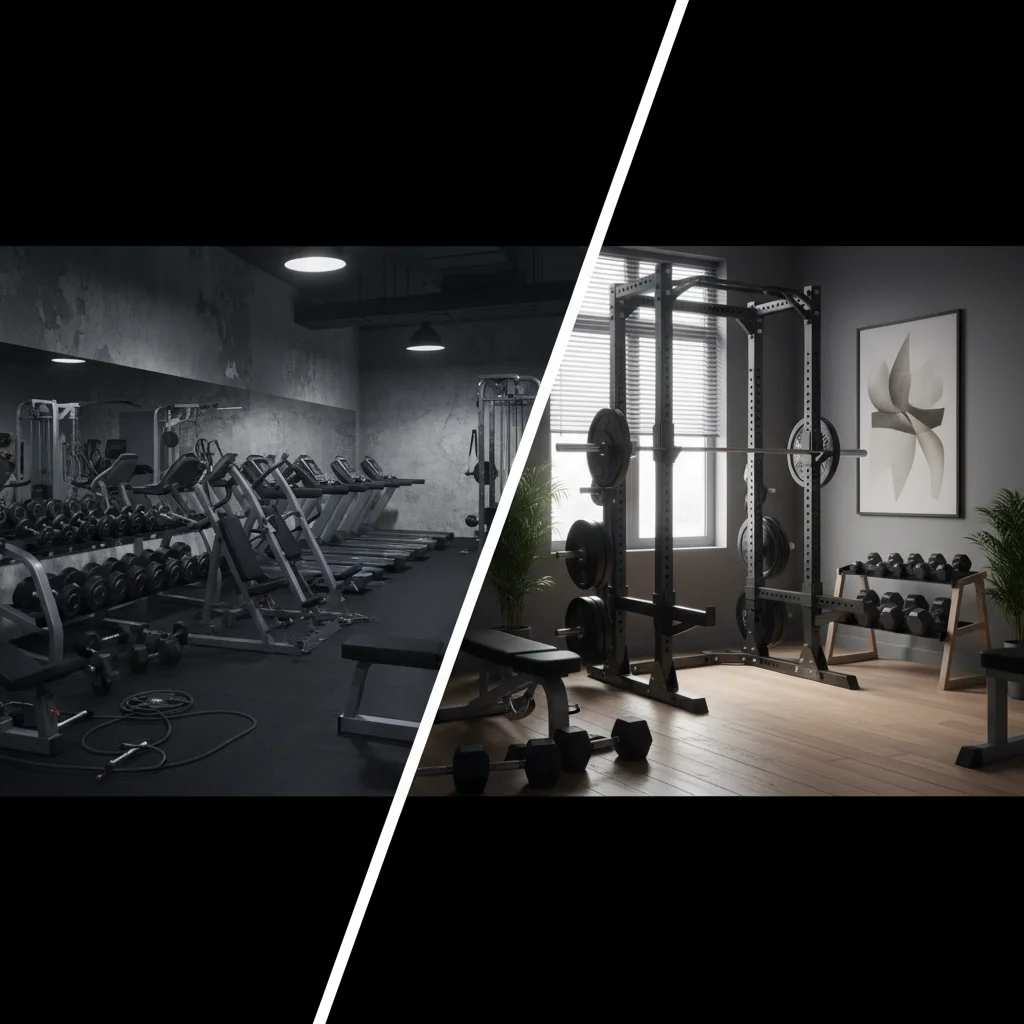
Numbers don’t lie. Here’s what you’d spend on a typical gym membership ($50/month) compared to a one-time home gym investment over 1, 2, and 3 years:
| Time Period | Gym Membership ($50/mo) | Budget Home Gym ($400) | Mid-Range Home Gym ($1,500) | Smart Home Gym ($2,500 + $49/mo) |
|---|---|---|---|---|
| Year 1 | $600 | $400 | $1,500 | $3,088 |
| Year 2 | $1,200 | $400 | $1,500 | $3,676 |
| Year 3 | $1,800 | $400 | $1,500 | $4,264 |
| 5-Year Total | $3,000 | $400 | $1,500 | $5,440 |
The budget and mid-range home gyms break even within the first year or two — and every month after that is free. Even the smart home gym with its monthly subscription fee gets competitive around the 5-year mark when you factor in premium gym memberships ($80+/mo) and the time savings of not commuting.
This is the sweet spot for most people ditching their gym membership for the first time. For the price of 6–10 months of gym dues, you get equipment that lasts a decade.
Hundreds of exercises. Chest press, rows, shoulder press, curls, lunges, goblet squats, flyes, tricep extensions, lateral raises — you name it. An adjustable dumbbell and bench setup covers roughly 80% of the exercises you’d do in a commercial gym.
Beginners, apartment dwellers, and anyone who wants a no-excuses setup without spending serious money. This is also a great starter setup that you can expand over time.
This is where a home gym starts to rival — and in many ways surpass — what you get at a commercial gym. At this budget, you can build a proper barbell setup or a premium dumbbell station with a cardio machine thrown in.
Everything. Squats, bench press, deadlifts, overhead press, barbell rows, pull-ups, dips — every major compound and isolation exercise. This setup supports serious training programs like Starting Strength, 5/3/1, PPL splits, and beyond.
People who are serious about strength training and have a garage, basement, or dedicated room. If you follow a structured lifting program and want to train with real weights, this is the tier to aim for.
Smart home gyms are the newest category, and they’ve gotten genuinely good. These wall-mounted or freestanding machines use digital resistance, AI-driven coaching, and guided workouts to pack an entire gym into a few square feet of space.
Smart gyms excel at coaching, compactness, and convenience. They fall short on maximum resistance (most top out at 200–220 lbs total) and ongoing cost (subscriptions add $200–600/year). If you need heavy loads for powerlifting, free weights win. If you want guided training in a small footprint with no clutter, a smart gym is hard to beat.
Tech-forward trainers, people with very limited space, and anyone who values built-in coaching and structured programs over raw lifting capacity.
This is the true minimalist route — and it’s far more effective than most people give it credit for. Calisthenics athletes, military personnel, and martial artists have built impressive physiques with nothing but their own body weight and a few simple tools.
A bodyweight circuit of pull-ups, push-ups, squats, dips, lunges, and planks — done 3–4 times per week — is enough to build a solid foundation of strength and muscle. Add in 2–3 outdoor runs per week and you’ve got a complete fitness program for under $200 total.
Travelers, people on a tight budget, outdoor enthusiasts, and anyone who wants to prove that expensive equipment isn’t a prerequisite for getting in shape. This setup is also an excellent complement to any other option — keep the pull-up bar and bands even if you later upgrade to a full home gym.
Fitness apps have exploded in quality over the past few years. If your main barrier is knowing what to do (not having equipment to do it with), a well-designed app can replace a personal trainer at a fraction of the cost.
Apps are excellent for coaching and motivation, but they don’t replace equipment. A strength-training app is only as good as the weights you pair it with. That said, combining a $13/month Peloton App subscription with a $400 home dumbbell setup gives you a guided, structured training experience that beats most commercial gym memberships in both cost and convenience.
Peloton App ($13/mo) + budget home gym ($400 one-time) = $556 in Year 1 and $156/year after that. Compare that to $600–960/year for a gym membership — and you never have to wait for a bench or drive anywhere.
Canceling your gym membership isn’t the right move for everyone. Here’s an honest look at what you gain and what you give up.
In most cases, yes. The average gym membership costs $40–60 per month, which adds up to $480–720 per year. A solid home gym setup starts at $300–500 and lasts for years with zero recurring costs. Most home gyms pay for themselves within 6–12 months compared to a commercial gym membership. The only scenario where a gym membership might be cheaper long-term is if you need access to very specialized or expensive equipment like commercial cable machines, pools, or saunas.
Absolutely. With a pair of adjustable dumbbells, a bench, and some resistance bands, you can effectively train every muscle group. Even a minimal setup of a pull-up bar, resistance bands, and your own bodyweight is enough for a comprehensive workout. The key is progressive overload — as long as you can consistently increase the challenge, you can build muscle and improve fitness without ever stepping foot in a commercial gym.
For beginners, a budget home gym ($300–500) with adjustable dumbbells, a bench, and resistance bands is the best starting point. It’s affordable, takes up minimal space, and gives you enough equipment to follow any beginner program. Pair it with a free or low-cost training app for guided workouts, and you have everything you need. You can always upgrade and add equipment as you progress.
Smart home gyms like Tonal, Speediance, and Tempo offer a premium, guided training experience with digital resistance, real-time coaching, and space-saving designs. They’re worth it if you value structured programming, form feedback, and a compact footprint — and if the monthly subscription fee ($49/mo for Tonal) doesn’t bother you. However, for pure value, a traditional home gym with free weights gives you more resistance and exercise variety for less money. Smart gyms are best for people who need the motivation and guidance that comes with a built-in coach.
The main things you give up are access to heavy, specialized equipment (leg press, cable crossover, Smith machine), group fitness classes, pool and sauna access, and the social environment. If your training depends on machines you can’t replicate at home, a gym membership still makes sense. But if you primarily use free weights, dumbbells, and cardio machines, you can replicate 90% of your gym experience at home for a fraction of the long-term cost.
The complete budget setup guide. Everything you need to build a capable home gym for less than six months of gym dues.
New to home training? Start here. We cover what to buy first, how much space you need, and common mistakes to avoid.
Our top-ranked home gym equipment and setups for every budget. Side-by-side comparisons with real-world testing data.