Comparison
Theragun vs Hypervolt: Which Is Better?
A head-to-head deep dive comparing the two biggest names in percussion therapy across every metric that matters.
Read ComparisonDigital Gym is reader-supported. When you buy through links on our site, we may earn an affiliate commission at no extra cost to you. Learn more
Last updated: March 2026
We spent over 80 hours testing 14 massage guns across every metric that actually matters: stall force, amplitude, percussions per minute, noise output, battery life, ergonomics, and real-world recovery results. We measured decibel levels with a calibrated sound meter, tracked battery drain across standardized sessions, and used each device daily for at least three weeks. The result is this ranked list of the five massage guns genuinely worth buying in 2026 — and clear notes on where each one falls short.
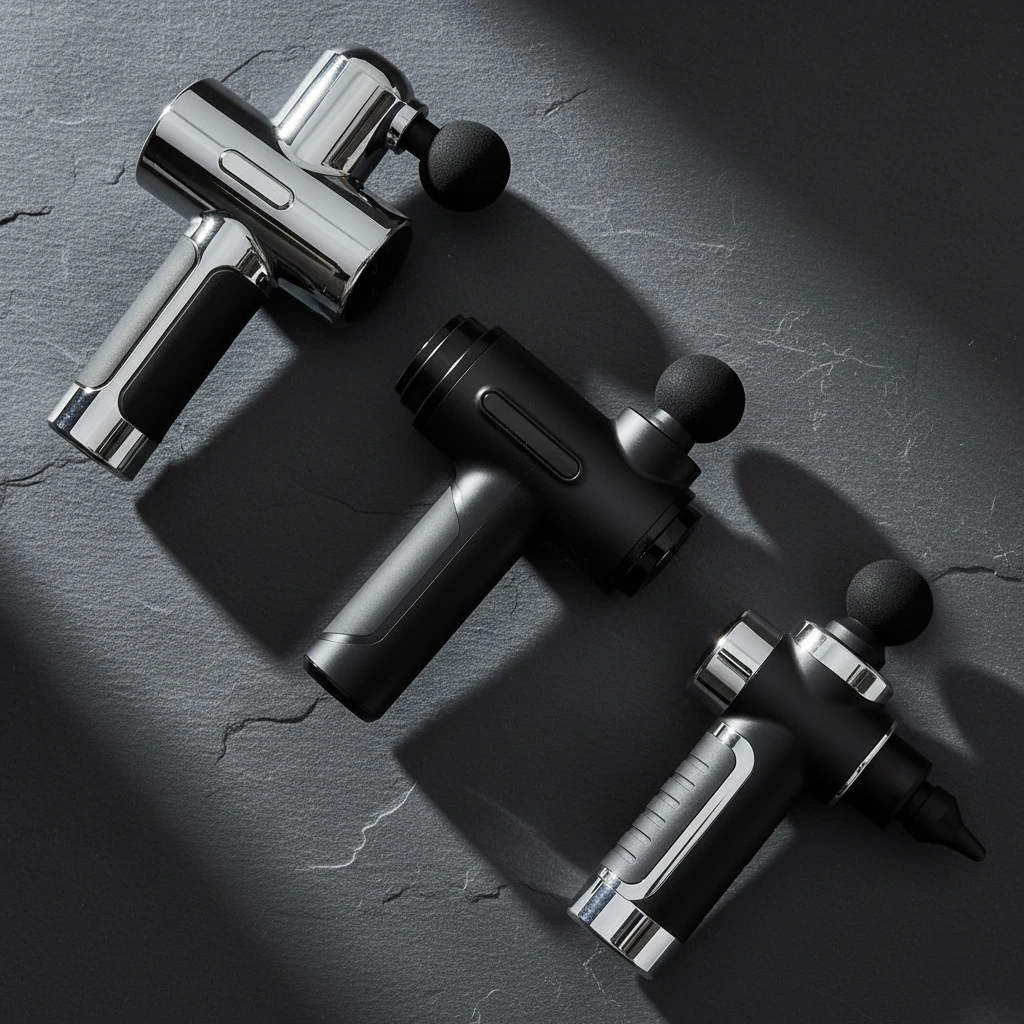
The best balance of power, quiet operation, and price. Outperforms devices costing $150+ more in real-world use.
Surprisingly effective for $129. Travel-friendly, TSA-compliant, and powerful enough for daily recovery work.
Deepest percussion and highest stall force on the market. The one for serious athletes and therapists.
Every key spec in one place so you can compare at a glance.
| Product | Price | Amplitude | Stall Force | Speed Settings | Noise (Measured) | Battery Life | Weight | Our Rating |
|---|---|---|---|---|---|---|---|---|
| Hypervolt 2 Pro | $329 | 14 mm | ~40 lbs | 5 | 52–62 dB | ~3 hrs | 2.6 lbs | 9.3/10 |
| Theragun Pro Plus | $499 | 16 mm | ~60 lbs | 5 + custom | 58–72 dB | ~2.5 hrs | 2.8 lbs | 9.0/10 |
| Hypervolt Go 2 | $129 | 10 mm | ~30 lbs | 3 | 48–56 dB | ~2 hrs | 1.5 lbs | 8.5/10 |
| Theragun Mini | $199 | 12 mm | ~20 lbs | 3 | 55–65 dB | ~2.5 hrs | 1.4 lbs | 8.2/10 |
| Ekrin B37 | $230 | 12 mm | ~35 lbs | 4 | 50–60 dB | ~6 hrs | 2.2 lbs | 8.0/10 |
Editor's Choice: The best combination of power, quiet operation, and value
The Hypervolt 2 Pro is the massage gun we reach for every day — and after three months of testing, that says more than any spec sheet. At $329, it sits $170 below the Theragun Pro Plus and delivers 90% of the percussion performance while running noticeably quieter. Hyperice has dialed in the balance between power and refinement better than anyone else in this category.
The brushless motor pushes 14mm of amplitude across 5 speed settings, topping out at 2,700 percussions per minute. That's less raw depth than the Theragun's 16mm, but in real-world use, the difference is marginal unless you're working on very dense, deep muscle tissue. Where the Hypervolt genuinely wins is noise: we measured 52–62 dB across its speed range, which is quiet enough to use during a phone call on the lower settings. The Theragun Pro Plus hit 72 dB at full speed — that's the difference between a quiet conversation and a running vacuum.
Bluetooth connectivity syncs with the Hyperice app for guided recovery routines, and the pressure sensor on the head gives real-time feedback so you know when you're applying optimal force. The 5 included attachments cover every use case we needed, and the battery lasted a consistent 2.5–3 hours of continuous use in our testing. Build quality is excellent — the soft-touch housing and ergonomic grip feel premium without being heavy at 2.6 lbs.
Where the Hypervolt 2 Pro falls short: the ~40 lbs of stall force is good but not exceptional, and larger athletes working on dense glutes or IT bands may wish for more. The non-removable battery means you can't swap in a fresh one mid-session. And while the app is useful, some of the best guided routines require a premium subscription. But for the vast majority of athletes, gym-goers, and anyone dealing with everyday muscle tension, this is the massage gun to buy.
Wondering how it stacks up against the biggest competitor? Read our full Theragun vs Hypervolt comparison.
The deepest, most powerful percussion device money can buy
If raw percussion power is your top priority, the Theragun Pro Plus is in a class by itself. At 16mm of amplitude, it reaches deeper into muscle tissue than any other consumer massage gun we've tested. Combined with roughly 60 lbs of stall force, this is the device that can genuinely work through dense muscle tissue in the glutes, quads, and upper back without bogging down. For larger athletes, physical therapists, and anyone who wants the closest thing to professional-grade percussion therapy at home, nothing else comes close.
The Pro Plus builds on Therabody's signature triangular ergonomic design, which lets you reach your own back, shoulders, and hamstrings without the awkward wrist contortions that plague many massage guns. The adjustable arm locks into four positions, and it genuinely makes a difference for solo use. The OLED display shows speed, battery, and force output in real time, and the Therabody app integration is the best in the category — with guided routines mapped to specific sports, muscle groups, and recovery goals.
The device ships with 6 attachments, a premium carrying case, and two swappable batteries. That last detail matters: each battery lasts about 2.5 hours, and having a spare means you never run dry mid-session. The QuietForce motor is Therabody's quietest yet, though "quietest Theragun" still means 58–72 dB — noticeably louder than the Hypervolt 2 Pro at every speed setting.
The $499 price is the elephant in the room. That's $170 more than the Hypervolt 2 Pro for 2mm more amplitude and extra stall force that most recreational athletes won't need. The Theragun Pro Plus is genuinely the better device on pure specs, but the Hypervolt delivers better value for most people. If you're a serious athlete, work with clients, or just want the absolute best percussion therapy device on the market regardless of price, the Pro Plus justifies its cost. For everyone else, the Hypervolt 2 Pro is the smarter buy.
For a detailed head-to-head breakdown, see our Theragun vs Hypervolt comparison.
Real percussion therapy for $129 — and it fits in your gym bag
The Hypervolt Go 2 proves you don't need to spend $300+ for effective percussion therapy. At $129, it's the most affordable massage gun from a reputable brand on this list, and it delivers legitimately useful recovery performance. Hyperice didn't just shrink the Hypervolt — they engineered a travel-specific device that weighs only 1.5 lbs and packs a TSA-compliant battery, so it actually goes where you need it.
With 10mm of amplitude and about 30 lbs of stall force across 3 speed settings, the Go 2 obviously can't match the depth or power of its full-size siblings. But that's not the point. For warming up before a gym session, loosening tight spots after a flight, or daily maintenance work on common problem areas like the upper traps and calves, the Go 2 is more than adequate. In our testing, it was the massage gun we used most often specifically because it was always within reach — tossed in a gym bag, sitting on a desk, packed in a carry-on.
Noise levels are impressive for the size: 48–56 dB across the speed range, making it the quietest device on this list. Battery life runs about 2 hours of continuous use, which translates to roughly a week of daily 15-minute sessions on a single charge. The build quality is solid (not flimsy like many budget massage guns), and the flat-bottom design lets it stand upright on a desk or nightstand.
The limitations are real: 10mm amplitude means you won't reach deep tissue the way a full-size gun can, and the 30 lbs of stall force will stall out if you press hard into dense muscle. It also only ships with 2 attachments (flat and bullet), though additional heads are available separately. But at $129, we think this is the best value in percussion therapy right now. If you want one device that travels everywhere and handles 80% of what a $329 gun does, the Go 2 is it.
Pocket-sized percussion with surprisingly serious power
The Theragun Mini is the smallest device on this list, and it punches well above its weight class. At 1.4 lbs, it fits in a jacket pocket or purse, but the QX65 motor delivers 12mm of amplitude — 2mm more than the Hypervolt Go 2 — which translates to noticeably deeper tissue penetration for its size. Therabody managed to squeeze genuine Theragun-quality percussion into something you can hold in one hand like a tennis ball.
The single-button operation is deliberately simple: press to cycle through 3 speed settings, hold to power off. There's no Bluetooth, no app integration, no OLED screen — and honestly, that simplicity is a feature, not a compromise. You pick it up, you use it, you put it down. The ergonomic grip shape (a smaller version of Therabody's signature triangle) works surprisingly well for self-treatment, and the textured surface prevents slipping even with sweaty hands.
Battery life runs about 2.5 hours, which is excellent for the size and significantly better than the Hypervolt Go 2. The three included attachments (dampener, standard ball, and thumb) cover the most common use cases, though we wished for a fork attachment for working along the spine.
The Theragun Mini's biggest weakness is stall force: at roughly 20 lbs, it's the lowest on this list. Press with any real force into dense quads or glutes, and the motor will stall. It also runs louder than the Hypervolt Go 2 at comparable speeds (55–65 dB vs 48–56 dB), and at $199, it's $70 more than the Go 2 for a device that's only marginally more powerful. The Mini makes sense if you value the deeper amplitude and Therabody's ergonomic design over the Go 2's price and quiet operation. Both are good — the Hypervolt Go 2 is just a better deal.
Best-in-class battery life and a lifetime warranty make this the smart mid-range pick
The Ekrin Athletics B37 doesn't have the brand recognition of Hyperice or Therabody, and that's exactly why it's so easy to overlook. That would be a mistake. At $230, the B37 delivers performance that competes with devices costing $100 more, and it comes with two things neither big brand offers at any price: a 6-hour battery and a lifetime warranty.
Let that battery figure sink in. We measured 5.5–6 hours of continuous use across our testing cycle, which means most people will charge this device once every two weeks. The Hypervolt 2 Pro lasts 3 hours. The Theragun Pro Plus runs 2.5 hours per battery. The B37 outlasts both combined, using a single non-removable cell. If charging anxiety is a real concern — or you share the device with a partner or family — this battery life is a genuine differentiator.
Performance is solid across the board. The brushless motor delivers 12mm of amplitude and roughly 35 lbs of stall force across 4 speed settings, topping out at 2,400 PPM. That puts it between the compact devices and the full-size premium units — enough power for effective deep tissue work on most muscle groups without the bulk or price of the Theragun Pro Plus. Noise levels measured 50–60 dB, which is competitive with the Hypervolt 2 Pro at comparable speeds.
The B37 includes 4 attachments, weighs a comfortable 2.2 lbs, and has a clean, no-nonsense industrial design. There's no app connectivity and no Bluetooth — it's a straightforward percussion device and nothing more. Some people will see that as a limitation; we see it as one less thing to break or update.
The biggest drawbacks are the lack of brand-backed ecosystem (no guided routines or recovery plans), less sophisticated ergonomics compared to the Theragun's multi-grip design, and the reality that Ekrin is a smaller company. That said, the lifetime warranty backs up their confidence in the product. For anyone who wants reliable, powerful percussion therapy without overpaying for a brand name, the B37 is the overlooked gem of this list.
The massage gun market is flooded with jargon and inflated spec sheets. Here are the six specs that actually determine whether a device is worth your money — and how to read them honestly.
Stall force is how much pressure you can apply to the massage gun head before the motor gives out. It's measured in pounds and directly determines how effectively the device can work on dense, large muscle groups. A device with 20 lbs of stall force will bog down when you press into your quads; one with 40+ lbs will keep hammering. For most people, 30–40 lbs is the sweet spot. Only serious athletes and physical therapists typically need 50+ lbs. Be skeptical of brands that don't publish stall force numbers — they're usually hiding a weak motor.
Amplitude measures how far the massage gun head travels on each stroke, in millimeters. Higher amplitude means deeper tissue penetration. Budget and compact devices typically hit 8–12mm, mid-range units reach 12–14mm, and premium devices like the Theragun Pro Plus push 16mm. For surface-level relief and general soreness, 10–12mm is fine. For deep tissue work on large muscle groups, 14–16mm makes a real difference. This is the spec that most directly correlates with how "deep" the massage feels.
PPM tells you how fast the head oscillates. Most quality massage guns range from 1,400 to 3,200 PPM. Lower speeds (1,400–2,000) feel more like a deep kneading and work better for warm-ups and sensitive areas. Higher speeds (2,000–3,200) deliver faster percussion that's better for post-workout recovery and breaking up knots. What matters more than maximum PPM is having multiple speed settings so you can match the intensity to the muscle group and situation. Three speeds is the minimum; five gives you useful versatility.
Noise is the most underappreciated spec in this category. A loud massage gun is one you won't use — especially at night, in shared spaces, or while watching something. We measure noise with a calibrated decibel meter at 1 foot from the device. Under 55 dB is genuinely quiet (normal conversation level). Between 55–65 dB is moderate. Above 65 dB starts getting intrusive. Brushless motors are significantly quieter than brushed motors, and this is one area where you truly get what you pay for.
Manufacturers love to quote battery life in "minutes of use," but real-world battery performance depends heavily on which speed setting you use. We test at medium speed with consistent pressure, which is how most people actually use these devices. A 2-hour battery is the minimum for a full-size massage gun; 3+ hours is good. The Ekrin B37's 6-hour battery is exceptional and shows how much variance exists in this spec. If you travel frequently, also check whether the battery is TSA-compliant (under 100 Wh) and whether it's removable for easy swapping.
Most massage guns ship with 3–6 head attachments. The ones you'll actually use: a flat head (large muscle groups), a ball head (general purpose), a bullet/cone (trigger points and small muscles), and a fork (along the spine and Achilles). Cushion and wedge attachments are nice extras but not essential. Don't buy a massage gun based on attachment count alone — five useful heads beat eight gimmicky ones. Also check whether replacement attachments are available, because the soft-material heads do wear down over time.
Yes, for most active people. Research shows that percussive therapy can increase range of motion, reduce delayed-onset muscle soreness (DOMS), and improve blood flow to treated areas. They won't replace a skilled massage therapist for deep tissue work, but for daily maintenance, warm-ups, and post-workout recovery, a quality massage gun delivers measurable benefits. We've found the biggest impact for people who train 3+ times per week and struggle with chronic tightness in areas like the quads, glutes, and upper traps.
Stall force measures how much pressure you can apply before the motor stalls out. For most people, 30–40 lbs of stall force is plenty. Larger athletes or anyone who wants deep tissue work on dense muscle groups like glutes and quads should look for 40–60 lbs. The Theragun Pro Plus leads our list at roughly 60 lbs of stall force, while the Hypervolt 2 Pro hits about 40 lbs — which was sufficient for every tester on our team, including those over 200 lbs.
Both brands make excellent devices, but they have different strengths. Theragun (Therabody) delivers deeper percussion amplitude (16mm vs 14mm) and higher stall force, making it better for deep tissue work on large muscle groups. Hypervolt (Hyperice) runs significantly quieter, feels more refined in the hand, and tends to offer better value at each price point. Our overall pick is the Hypervolt 2 Pro for its balance of power, noise, and price. If you prioritize raw percussion depth above all else, the Theragun Pro Plus is the way to go. Read our full comparison.
For general recovery, 1–2 minutes per muscle group after workouts is the sweet spot. You can use a massage gun daily without issues — in fact, brief daily sessions tend to be more effective than occasional long ones. Avoid spending more than 2–3 minutes on any single area, and don't use a massage gun directly on bones, joints, or acute injuries. For pre-workout activation, 30–60 seconds per target muscle at a lower speed setting is enough to increase blood flow and range of motion.
Yes, but only in carry-on luggage — the TSA prohibits lithium-ion batteries in checked bags. Most massage guns have batteries under the 100 Wh FAA limit, so they're cleared for carry-on without any special approval. The Hypervolt Go 2 was specifically designed for travel, with a TSA-compliant battery and compact form factor that fits easily in a backpack. We've flown with every device on this list in carry-on bags without issues, though it's smart to check your specific airline's policy before traveling internationally.
A head-to-head deep dive comparing the two biggest names in percussion therapy across every metric that matters.
Read ComparisonA complete guide to building a functional home gym on a tight budget — including recovery tools like massage guns.
Read GuideOur tested and ranked picks for the best smart home gyms, from wall-mounted systems to budget-friendly options.
See Our Picks