Guide
Best Home Gym Under $1,000
Three proven setups for under a grand. The perfect starting point if you want a capable home gym without a big upfront investment.
Home › Guides › Home Gym Under $2,000
Last updated: March 2026
Two thousand dollars is the sweet spot for a home gym. It’s enough to move past the budget-tier compromises and build something that genuinely feels like a real training facility — a sturdy power rack, a quality barbell, plenty of plates, a solid bench, and still have room left for cardio equipment or a smart gym alternative.
We’ve tested and priced out three complete setups at this budget. Whether you want a full-blown strength station, a balanced cardio-and-lifting setup, or a space-saving smart gym, there’s a build here for you. Every recommendation is based on real-world pricing, hands-on testing, and thousands of owner reviews. No filler — just what to buy, what to skip, and why.
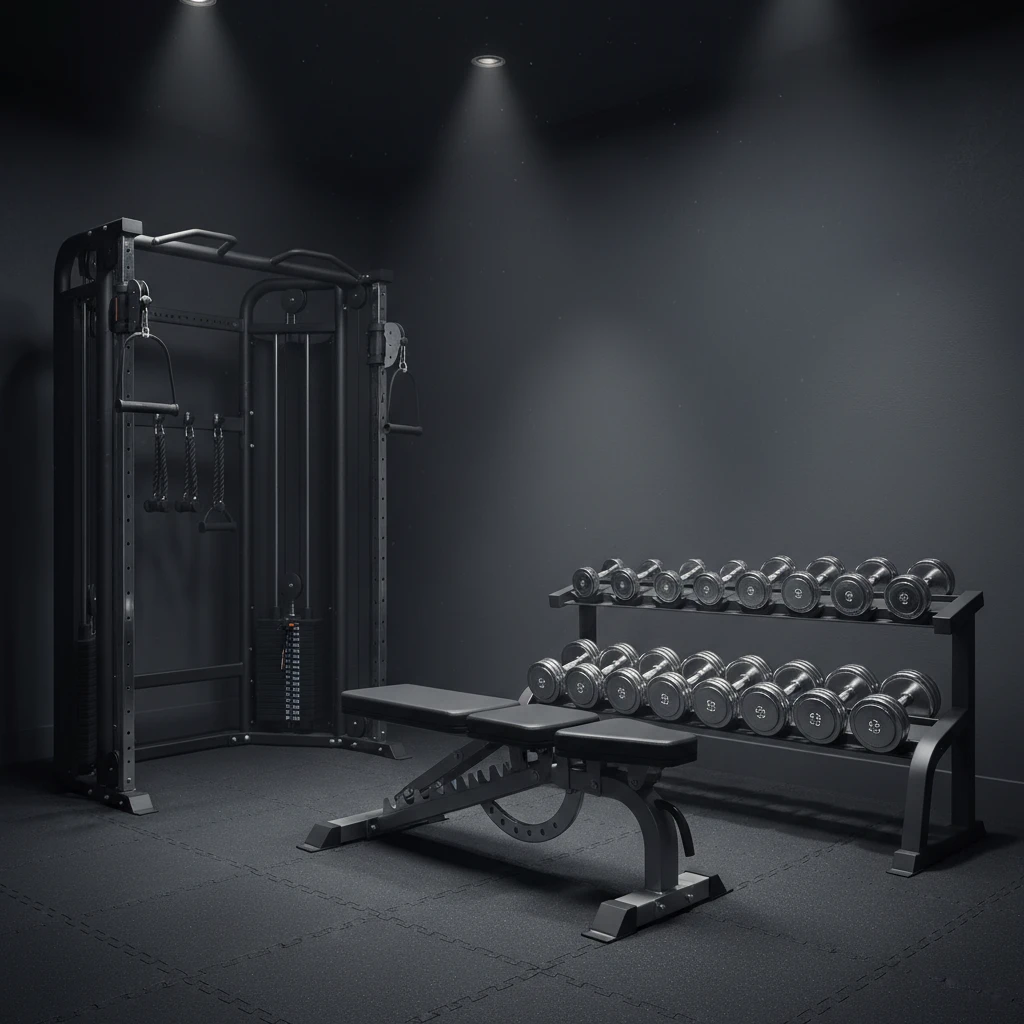
At $1,000, you’re choosing between a strength setup or a cardio machine — rarely both. At $2,000, you stop making trade-offs. This budget gets you into genuinely mid-tier equipment that feels better, lasts longer, and holds its resale value if you ever upgrade.
These pieces should eat about 70–80% of your budget. Get these right and everything else is gravy:
Here’s where the extra thousand dollars actually goes:
Splurge on: Your power rack and barbell. These are safety-critical items and long-term investments. A good rack and bar last 20+ years. At $2,000, you can afford to get these right.
Save on: Weight plates (iron is iron — buy used if possible), flooring (horse stall mats at $40–50 each beat any “gym flooring” product), and small accessories like bands, clips, and chalk.
This is the build for serious lifters. If your training revolves around squats, bench press, deadlifts, overhead press, and barbell rows, this setup gives you everything you need at a quality level that won’t hold you back for years. It’s the home gym equivalent of a well-equipped commercial strength training area.
The REP PR-4000 is the best value power rack in the mid-tier market, and it’s not particularly close. It’s a 3x3-inch 11-gauge steel frame with a 1,000 lb weight capacity, Westside hole spacing throughout the bench zone, and compatibility with a massive library of attachments — dip horns, lat pulldowns, cable crossovers, landmine pivots, and more.
At around $621 for the base rack (price varies with configuration), you get numbered uprights, band pegs, and a multi-grip pull-up bar. The fit and finish is a clear step above budget racks like the Titan T-3. Tolerances are tighter, bolts line up on the first try, and the powder coat is noticeably better. This rack will last 20+ years in a home gym environment.
Configuration tip: Order the 80-inch height if your ceiling allows it. The 93-inch version is great for overhead pressing inside the rack but needs at least a 9-foot ceiling.
At this budget, you can afford a barbell that actually feels good to use. Two strong options:
REP Sabre Bar (~$200): A 28.5mm shaft with solid knurling, 1,500 lb static rating, and decent sleeve spin. It punches way above its price and pairs perfectly with the PR-4000. This is the value pick.
Rogue Bar 2.0 (~$350): If you can stretch the budget, this is a buy-it-for-life barbell. 190K PSI tensile strength steel, composite bushings, and Rogue’s signature knurl pattern. The feel is immediately noticeable compared to any sub-$200 bar. It’s the bar most serious home gym owners eventually end up buying anyway.
You need at least 300 lbs to start. A standard Olympic weight set includes a mix of 45, 35, 25, 10, 5, and 2.5 lb plates. New iron plates run about $1.00–1.50 per pound in 2026. Budget bumper plates (like the REP Equalizers) start around $1.50 per pound and are worth considering if you plan to do any Olympic lifting or want to deadlift without shaking the house.
Pro tip: Buying used iron plates on Facebook Marketplace or Craigslist can cut this cost by 40–60%. Iron doesn’t wear out. A scratched 45 lb plate still weighs 45 lbs and works identically to a brand-new one.
The REP AB-3000 is one of the best adjustable benches under $300. It has a flat position, multiple incline angles up to 85 degrees, a 1,000 lb weight rating, and a thick pad with good grip. The 3-post design is rock-solid and won’t wobble during heavy pressing.
If you want to save $50–100, the Flybird adjustable bench (~$140) is a decent alternative, but you’ll feel the difference in stability at heavier weights. At a $2,000 total budget, the AB-3000 is worth the money.
Two 4x6-foot rubber horse stall mats from Tractor Supply Co. (~$50 each) give you a 4x12-foot or 8x6-foot lifting platform. They’re 3/4-inch thick, virtually indestructible, and protect your floor from dropped weights. This is the same material used in commercial gyms. Skip the expensive “gym flooring” tiles — stall mats perform just as well at a fraction of the cost.
A set of fractional plates (0.25, 0.5, 0.75, 1.0 lb pairs, ~$30–$40) lets you microload your barbell for steady progression on pressing movements. A set of loop resistance bands (~$20) handles warm-ups, face pulls, and band pull-aparts. Optional: add a pair of barbell clips (~$15) and chalk ($10).
Even at the high end with a Rogue bar, you’re under $1,800. That leaves $200+ in the budget for future additions — dip attachment for the rack (~$60), a set of bumper plates, or a wall-mounted pull-up bar for outside the rack.
Powerlifters, strength athletes, and anyone running a barbell-centric program like 5/3/1, Starting Strength, GZCLP, or nSuns. This setup has zero limitations for intermediate lifters and will serve most advanced lifters well too. It’s also the most expandable — the PR-4000 accepts enough attachments to grow with you for years. Plan for an 8x10-foot footprint minimum.
Why choose between lifting and cardio when you can have both? This setup takes the strength foundation from Option 1 and adds a world-class rowing machine. It’s the most well-rounded home gym you can build under $2,000.
Same rack as Option 1. The PR-4000 is the foundation. At this budget, there’s no reason to downgrade to a lesser rack — you’ll just want to upgrade later.
We go with the Sabre Bar here instead of the Rogue to keep room in the budget for the cardio machine. At $200, it’s still a very capable barbell that handles heavy squats and deadlifts without complaint. The trade-off vs. the Rogue Bar 2.0 is minor for most lifters.
Same recommendation as Option 1. Hunt for used plates to save money here — every dollar you save on plates is a dollar that can go toward the rower or bench.
If the budget feels tight, this is where you can flex. The REP AB-3000 (~$250–$300) is the better bench, but the Flybird (~$140) works fine if you need to prioritize the cardio machine. Both get the job done.
The Concept2 RowErg (~$990) is the single best cardio machine you can buy at any price. It’s the standard in CrossFit boxes, rowing clubs, and commercial gyms worldwide. The air resistance feels smooth and natural, the PM5 monitor tracks every metric you’d want, and the build quality is legendary — these machines routinely last 15–20 years with minimal maintenance. It also stores vertically, which is a major plus for space-limited gyms.
If $990 pushes you over budget, consider these alternatives:
Same as Option 1. Two stall mats cover your lifting area. The rower can sit on bare floor or on a thin rubber mat.
With the Concept2 RowErg, you’re at the top of the budget. With a budget rower or used Concept2, you come in well under $2,000 with room for accessories. Either way, you end up with both a complete strength training station and a legitimate cardio machine.
People who want balanced fitness — strength and cardiovascular conditioning in the same space. This is an excellent build for CrossFit-style training, general athletic preparation, or anyone who wants to lift heavy and still have great cardio capacity. The Concept2 is also one of the best tools for active recovery on rest days. Plan for a 10x10-foot space to fit everything comfortably.
At $2,000, you’re shopping in the mid-tier market where quality differences between brands actually matter. Here’s what to prioritize in each equipment category.
At this budget, you want a 3x3-inch or 2x3-inch steel rack with at least a 1,000 lb weight capacity. Key features to look for:
Our top picks: REP PR-4000 ($621–$700), Titan X-3 ($600–$700), Rep PR-5000 ($750–$850 if you can stretch).
The barbell is the single most-used piece of equipment in a strength-focused gym. At this budget, you should expect:
Our top picks: REP Sabre Bar ($200), Rogue Bar 2.0 ($350), Bells of Steel Barenaked Bar ($250).
You have two main categories at this budget:
At $2,000, most lifters are best served by a 300 lb cast iron set plus 2–4 bumper plates (a pair of 45s and a pair of 25s) for deadlifts and Olympic work. Or go all-iron and put the savings elsewhere.
An adjustable bench should be stable at every angle, easy to adjust, and have a pad that grips your back without sliding. At this budget, look for:
If your budget allows for cardio alongside your strength setup, here are the best options ranked by value:
After the big-ticket items, put whatever is left toward:
Not everyone wants a garage full of iron. If you’re short on space, prefer guided workouts, or just want something that looks clean in a spare bedroom, a smart gym is a legitimate alternative at this budget.
The Speediance GymMonster is the most capable smart gym you can get under $2,000. It uses a digital resistance system that provides up to 220 lbs of smooth, cable-style resistance through two independent arms. It replaces a cable machine, a functional trainer, and to a large extent, a set of dumbbells — all in a footprint roughly the size of a small bookshelf.
Key features:
Smart gyms are not for everyone. Here’s what you give up compared to a traditional setup:
Apartment dwellers, people with limited space, beginners who want guided workouts, and anyone who values aesthetics and convenience over raw strength potential. If your training goals are general fitness, muscle building up to an intermediate level, and functional movement — and you don’t want to deal with loading plates and chalking up — the Speediance GymMonster is genuinely excellent. Just go in with realistic expectations about its limitations.
| Feature | Option 1: Strength-Focused | Option 2: Cardio + Strength | Option 3: Smart Gym |
|---|---|---|---|
| Total Cost | ~$1,550–$1,800 | ~$1,600–$1,900 | $1,799 + $39/mo |
| Key Equipment | Power rack, barbell, 300 lb plates, adjustable bench, mats | Power rack, barbell, plates, bench, Concept2 rower | Speediance GymMonster all-in-one |
| Space Required | Large (8x10 ft) | Large (10x10 ft) | Small (5x6 ft) |
| Max Resistance | Unlimited (add more plates) | Unlimited (add more plates) | 220 lbs digital |
| Cardio Included | No (add separately) | Yes (rower) | Cardio modes built in |
| Best For | Powerlifting, serious strength | Balanced fitness, CrossFit-style | Small spaces, guided training |
| Exercise Variety | Moderate (compound-focused) | High (compounds + rowing) | Very high (100+ exercises) |
| Expandability | Excellent (plates, rack attachments) | Excellent | Limited (software updates only) |
| Ongoing Costs | None | None | $39/month subscription |
| Apartment-Friendly | No | No | Yes |
| Ideal Training Style | 5/3/1, GZCLP, powerlifting | CrossFit, hybrid strength + cardio | General fitness, hypertrophy, guided |
Rack, barbell, and plates should get the lion’s share of your budget. These are the items you use every single session, and their quality directly affects your training. Accessories are easy to add later — a bad rack or barbell haunts you for years.
This advice appears in every home gym guide because it’s the most impactful money-saving tip there is. Used iron plates at $0.50–$0.75 per pound vs. $1.00–$1.50 new means you save $75–$300 on a 300 lb set. Put those savings toward a better barbell or a cardio machine.
Measure your room before ordering. A PR-4000 rack is about 49 inches wide, 48 inches deep, and 80–93 inches tall. You need at least 24 inches of clearance on each side for plate loading, and enough depth for the barbell to clear the front of the rack. Add a rower and you need another 8–9 feet of length. Sketch it out on paper first.
A common mistake is spending $1,200 on a Rogue RML-490 rack and then having $800 left for everything else. The rack is amazing, but now your barbell, plates, bench, and flooring all suffer. A $700 rack with a $300 barbell beats a $1,200 rack with a $100 barbell every time. Balance your spending.
Dropping a loaded barbell on a bare concrete or wood floor is a fast way to destroy both the floor and your plates. Two horse stall mats cost $80–$100 and solve this problem completely. Budget for them from the start, not as an afterthought.
The jump from a $120 bar to a $200 bar is the single biggest quality improvement per dollar in the entire home gym. A cheap bar with poor knurling, a low tensile strength rating, and bad sleeve spin makes every workout worse. Spend $200 minimum on a barbell — at a $2,000 budget, you can absolutely afford it.
Racks and plates are heavy. Shipping a fully configured PR-4000 can add $100–$200 depending on your location. REP offers free shipping on orders over $99, but other brands may not. Factor shipping into your total budget from the start, not at checkout.
Yes, and the math backs it up. A typical commercial gym membership runs $40–$80 per month, which is $480–$960 per year. A $2,000 home gym pays for itself in 2–4 years and lasts well over a decade with minimal maintenance. More importantly, at this budget you’re getting genuinely high-quality equipment — a solid power rack, a good barbell, enough plates for most lifters, and still have room for cardio or accessories. It’s a real training facility, not a compromise.
Equipment quality and completeness. At $1,000, you’re picking either a barbell setup or cardio — rarely both. At $2,000, you can have a high-quality power rack, a good barbell, plenty of plates, an adjustable bench, and still have $300–$500 left for cardio equipment, flooring, or accessories. You also move from entry-level gear to mid-tier equipment that feels noticeably better and lasts longer.
At a $2,000 budget, get the power rack. Squat stands are fine for lighter loads, but a full rack gives you built-in safety bars so you can fail a squat or bench press without a spotter. The REP PR-4000 or similar racks also come with pull-up bars and support dozens of attachments you can add later — dip horns, lat pulldowns, cable systems. It’s the foundation that your entire gym grows around.
It depends on what you value. Smart gyms like the Speediance GymMonster ($1,799) offer a compact, guided training experience with digital resistance, built-in coaching, and a small footprint. They’re excellent for people who want simplicity and don’t enjoy programming their own workouts. But they max out at around 220 lbs of resistance and you’ll pay a monthly subscription ($39/month for Speediance). A traditional setup gives you heavier loads, no subscription fees, and more equipment variety — but requires more space and self-direction.
Start with the power rack, barbell, and plates — this combination gives you the most exercises per dollar and lets you follow any serious strength program. Add an adjustable bench next, since it dramatically expands your pressing options. Flooring (horse stall mats) should come third for safety and noise reduction. Cardio equipment and accessories are last — you can always run outside, jump rope, or do burpees for cardio while you save up for a rower or bike.
Three proven setups for under a grand. The perfect starting point if you want a capable home gym without a big upfront investment.
Our top-ranked power racks at every budget. Detailed specs, comparisons, and recommendations for home gym lifters.
A head-to-head comparison of the two most popular home gym brands. Quality, pricing, warranty, and who should buy which.