Guide
Best Home Gym Under $1,000
Ready to invest more? At $1,000 you can add a power rack, barbell, and plates for serious strength training at home.
Five hundred dollars won’t buy you a commercial gym. But it will buy you a home gym that’s genuinely useful — one that covers the exercises most people actually do, takes up minimal space, and pays for itself in less than a year compared to a monthly membership.
We’ve built three complete setups at $200, $350, and $500. Each one is a real, trainable gym — not a wish list. Every item is itemized with current pricing so you know exactly what to expect. Whether you’re a beginner on a tight budget or a lifter who just wants the essentials at home, there’s a setup here for you.
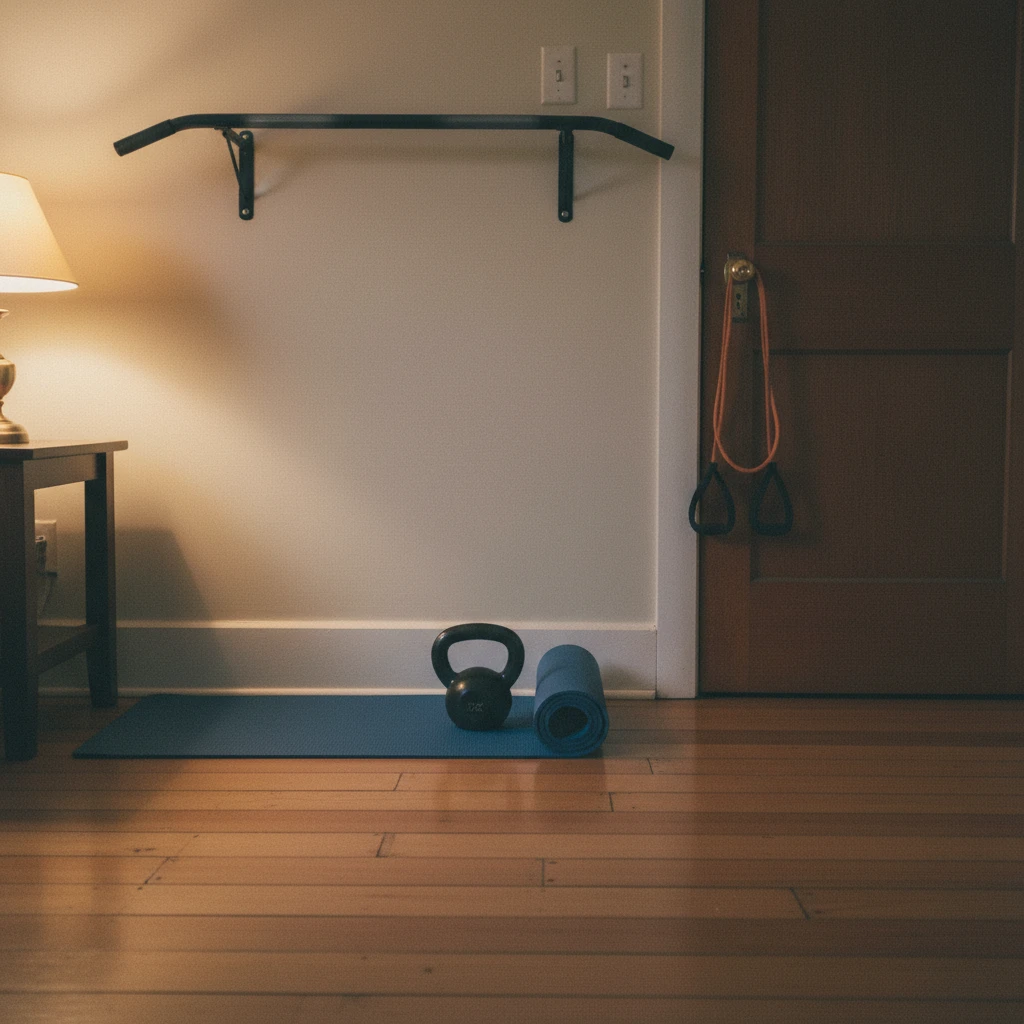
Let’s be straight about what’s realistic at this price point. You’re not getting a power rack, a barbell, or a stack of iron plates. But you don’t need any of that to build a gym that works. At $500, the smartest approach is a dumbbell-based setup supplemented with bodyweight training and resistance bands.
At this budget, you won’t have a barbell, power rack, or cable machine. That’s OK. Research consistently shows that dumbbell training is just as effective as barbell training for building muscle, and for most recreational lifters, dumbbells are actually more versatile. You can always add a barbell setup later if you want one.
Spend on: Your dumbbells. This is the one piece of equipment you’ll use every single workout. A quality adjustable dumbbell set lasts 10+ years and is the foundation of everything else you do.
Save on: Accessories. A $10 jump rope works just as well as a $40 one. A $20 yoga mat does the same job as a $70 one. Resistance bands are cheap across the board. Don’t overspend on items where quality differences don’t meaningfully affect your training.
This is the entry-level build for people who want to start training at home without a major financial commitment. It’s simple, effective, and takes up almost no space. Don’t let the low price fool you — this setup can support a legitimate training program.
Buy three pairs of hex dumbbells in weights that make sense for your current strength level. A common starting point for most men is 15 lb, 25 lb, and 35 lb. For most women, 8 lb, 15 lb, and 25 lb works well. Rubber hex dumbbells from CAP or Amazon Basics run about $1.00-1.50 per pound new.
Why fixed instead of adjustable at this budget? Because quality adjustable dumbbells cost $300+, and the cheap adjustable sets under $100 are wobbly, slow to change, and not worth the frustration. Three solid pairs of fixed dumbbells get the job done reliably.
A set of loop resistance bands (light, medium, heavy, extra heavy) adds dozens of exercise options. Use them for face pulls, band pull-aparts, lateral raises, banded squats, assisted pull-ups, and stretching. Brands like Fit Simplify and INTEY offer solid sets for $20-30.
A doorframe-mounted pull-up bar is one of the highest-value pieces of equipment you can buy. Pull-ups and chin-ups are among the best upper-body exercises, and hanging leg raises are a top-tier core exercise. The Iron Gym Total Upper Body (~$30) and the ProsourceFit Multi-Grip (~$35) are both solid choices that require no drilling or permanent mounting.
A basic 6mm yoga mat provides a comfortable surface for floor exercises, stretching, and core work. You don’t need anything fancy — the Amazon Basics 1/2-inch mat (~$20) works perfectly.
A speed jump rope is the cheapest and most effective cardio tool you can own. Ten minutes of jump rope burns roughly the same calories as 30 minutes of jogging, and it fits in a drawer. Any basic speed rope in the $8-15 range will do the job.
| Item | Estimated Cost |
|---|---|
| Fixed hex dumbbells (3 pairs) | $100 |
| Resistance bands set | $25 |
| Doorframe pull-up bar | $35 |
| Yoga mat | $20 |
| Jump rope | $10 |
| Total | ~$190 |
Beginners, people testing whether they’ll actually use a home gym before investing more, and anyone who wants a no-nonsense starter kit. This setup works great for general fitness, light hypertrophy training, and bodyweight-plus-dumbbell programs. It stores easily in a closet or corner of a room.
This is where the jump in capability gets serious. By spending $350, you go from a few pairs of dumbbells to a full adjustable dumbbell system with a bench. The exercise variety increases dramatically, and you can follow nearly any dumbbell-based training program out there.
The Bowflex SelectTech 552 adjusts from 5 to 52.5 lbs per hand using a dial-based system. That’s 15 weight settings per dumbbell, replacing 15 pairs of fixed dumbbells. The weight changes take about 3 seconds, the build quality is solid, and at around $250 during sales (regular price $429), they’re one of the best deals in fitness equipment.
At this budget, we’re recommending waiting for a sale or buying a lightly used pair. The SelectTech 552 regularly drops to $250-300 during Black Friday, Prime Day, and other major sales. Used pairs on Facebook Marketplace typically go for $200-280 in good condition.
A basic flat bench opens up all pressing movements, rows, step-ups, and more. The Amazon Basics Flat Bench (~$70) and the CAP Barbell Flat Bench (~$80) are both adequate at this price point. They’re not premium, but they hold 400-600 lbs and do exactly what a flat bench needs to do.
If you can stretch another $60-70, the Flybird adjustable bench (~$140) gives you incline and decline positions as well. But a flat bench is perfectly fine for getting started.
| Item | Estimated Cost |
|---|---|
| Bowflex SelectTech 552 (sale or used) | $250 |
| Flat bench | $80 |
| Total | ~$330 |
That leaves you about $170 under the $500 cap. You can add a pull-up bar ($35), resistance bands ($25), a yoga mat ($20), and a jump rope ($10), and still have money left over.
Intermediate-level fitness enthusiasts, people who want real progression in their dumbbell training, and anyone with limited space who still wants a serious workout. This is the setup we recommend most often for people building their first home gym on a budget. It hits the sweet spot between cost and capability.
This is the best $500 home gym we can build. It covers every major movement pattern — pushing, pulling, squatting, hinging, and core work — with enough resistance for most people to train seriously for years. If you’re spending the full $500, this is the build.
The PowerBlock Elite is our top pick for adjustable dumbbells in a $500 gym. At around $300 (regularly on sale from the $380 MSRP), they offer the best durability and expandability in this price range. The block-style design takes a workout or two to get used to, but the fast weight changes (under 5 seconds), solid steel construction, and ability to expand up to 70 or 90 lbs with add-on kits make them the better long-term investment.
If you prefer a more traditional dumbbell feel, the Bowflex SelectTech 552 (~$300-430) is an excellent alternative. It’s slightly more ergonomic but not expandable and a bit less durable. Both are great choices — it comes down to personal preference.
The Flybird adjustable bench is one of the best budget benches on the market. It goes from flat to multiple incline angles (and a slight decline), handles up to 620 lbs, and folds completely flat for storage. For a $500 gym, the ability to do flat presses, incline presses, seated shoulder presses, and incline rows makes the adjustable bench worth the extra cost over a flat-only model.
If you want to save $40-60, the Amazon Basics flat bench (~$70) or CAP flat bench (~$80) is a fine downgrade. You just lose the incline and decline positions.
Same recommendation as Option 1. A doorframe pull-up bar gives you pull-ups, chin-ups, neutral-grip pull-ups, and hanging core work. The ProsourceFit Multi-Grip or Iron Gym Total Upper Body are both reliable picks.
A set of loop bands for warm-ups, face pulls, band pull-aparts, and accessory work. These complement the dumbbells perfectly and add resistance curves you can’t get with free weights alone.
For floor work, stretching, and core exercises. A basic 6mm mat is all you need.
Your budget cardio machine. Effective, portable, and takes up zero space.
| Item | Estimated Cost |
|---|---|
| PowerBlock Elite adjustable dumbbells (5-50 lbs) | $300 |
| Flybird adjustable bench | $140 |
| Doorframe pull-up bar | $35 |
| Resistance bands set | $25 |
| Yoga mat | $20 |
| Jump rope | $10 |
| Total | ~$530 |
Yes, it’s slightly over $500 at full retail. But the PowerBlock Elite frequently drops to $280-300 on sale, and the Flybird bench goes on sale for $110-120 regularly. Watch for deals and you’ll land comfortably under $500. Buying the dumbbells used can save another $50-80.
Anyone who wants a genuinely complete home gym for the lowest possible price. This setup supports full-body dumbbell programs, hypertrophy training, HIIT circuits, and general fitness. It takes up about a 4x4-foot space when in use and stores in a closet when you’re done. It’s apartment-friendly, beginner-friendly, and capable enough for advanced lifters to get a real workout.
| Feature | Option 1: Starter ($200) | Option 2: Mid-Range ($350) | Option 3: Full ($500) |
|---|---|---|---|
| Total Cost | ~$190 | ~$330 | ~$530 (under $500 on sale) |
| Key Equipment | Fixed dumbbells, bands, pull-up bar | Adjustable dumbbells, flat bench | Adjustable dumbbells, adjustable bench, pull-up bar, bands |
| Max Dumbbell Weight | 35 lbs per hand (typical) | 52.5 lbs per hand | 50 lbs per hand (expandable to 90) |
| Space Required | Minimal (3x3 ft) | Small (4x4 ft) | Small (4x4 ft) |
| Best For | Beginners, testing the waters | Intermediate, best value | Serious training, long-term use |
| Exercise Variety | Moderate | High | Very high |
| Expandability | Limited (buy more pairs) | Moderate (not expandable) | Excellent (add weight kits up to 90 lbs) |
| Apartment-Friendly | Yes | Yes | Yes |
Resistance training is the core of any home gym. Here’s a closer look at each category of equipment and what to look for on a $500 budget.
If your budget allows, adjustable dumbbells are the single best purchase you can make. Here’s how the top options compare:
| Model | Weight Range | Price (MSRP) | Expandable | Best For |
|---|---|---|---|---|
| PowerBlock Elite | 5-50 lbs | $380 | Yes (up to 90 lbs) | Long-term investment, serious lifters |
| Bowflex SelectTech 552 | 5-52.5 lbs | $429 | No | Ease of use, traditional feel |
| NordicTrack Select-A-Weight | 10-55 lbs | $399 | No | Higher starting weight |
All three are solid choices. The PowerBlock Elite wins on expandability and durability. The Bowflex wins on ergonomics. The NordicTrack is a good middle ground. At this budget, buy whichever one you find the best deal on.
If adjustable dumbbells are out of your price range, three to five pairs of rubber hex dumbbells will get you started. Focus on weights you’ll actually use for the most exercises. A pair of 15s handles lateral raises and curls, 25s cover rows and presses for many people, and 35s handle heavier rows and goblet squats. Expect to pay $1.00-1.50 per pound new, or $0.50-0.75 per pound used.
A bench turns a dumbbell set into a full gym. Without one, you’re limited to standing and floor exercises. With one, you can do flat bench press, incline press, rows, step-ups, Bulgarian split squats, and more. At this budget, your main decision is flat vs. adjustable:
Bands are the most underrated piece of equipment in a home gym. A $20-30 set gives you variable resistance for warm-ups, rehab work, face pulls, pull-aparts, banded push-ups, and dozens of other movements. They also weigh almost nothing and store anywhere. Look for a set with at least 4 resistance levels.
You don’t need a $500 treadmill to get good cardio in a home gym. At this budget, the most effective cardio tools are the cheapest ones.
A speed jump rope is the best cardio tool per dollar in existence. It burns roughly 10-16 calories per minute (comparable to running at 8-minute-mile pace), improves coordination, and stores in a drawer. Any basic speed rope works — the Survival and Cross speed rope (~$10) and the WOD Nation speed rope (~$15) are both popular and effective.
Burpees, mountain climbers, high knees, jumping jacks, and squat jumps cost nothing and provide excellent cardiovascular conditioning. Combine these with your dumbbell work in circuit-style training for a workout that builds muscle and torches calories simultaneously.
Realistically, any decent cardio machine (treadmill, bike, rower) starts at $300-500. If you spend that on cardio, there’s nothing left for weights. Our recommendation at this budget: skip the machine. Use the jump rope and bodyweight cardio for now, and add a machine later when your budget grows. A used stationary bike on Facebook Marketplace ($50-100) is a reasonable compromise if you really want a machine.
Recovery equipment doesn’t need to be expensive to be effective. Here are the essentials at budget-friendly prices.
A basic exercise mat gives you a comfortable surface for stretching, foam rolling, and core work. The Amazon Basics 1/2-inch mat (~$20) and the BalanceFrom GoYoga mat (~$18) are both solid picks. Avoid ultra-thin mats (under 6mm) — your knees will thank you during lunges and planks.
A high-density foam roller is one of the best recovery tools you can buy. Use it before workouts to loosen tight muscles and after workouts to reduce soreness. A basic 18-inch or 36-inch high-density roller from Amazon Basics (~$15) or LuxFit (~$20) does the job. Skip the fancy vibrating rollers at this budget — they’re not meaningfully better for recovery.
A single lacrosse ball is the cheapest deep-tissue massage tool you’ll ever find. Use it on your shoulders, upper back, glutes, and feet. It’s more targeted than a foam roller and costs less than a cup of coffee. Grab a two-pack for under $10.
At a $500 budget with dumbbells as your primary equipment, you don’t need heavy-duty gym flooring. But some floor protection is smart.
If you’re training with dumbbells under 50 lbs, a thick exercise mat is usually enough. It protects hardwood and tile from accidental drops, cushions your knees for floor exercises, and defines your training space. This doubles as your stretching mat, so you’re getting two uses from one purchase.
If you want more coverage, a pack of interlocking EVA foam tiles covers a 4x4 or 4x6-foot area for $20-35. These are fine for dumbbell work, bodyweight training, and light equipment. They’re not suitable for heavy barbell drops, but at this budget, you don’t have a barbell anyway.
If you find one on sale or have a farm supply store nearby, a single 4x6-foot rubber horse stall mat ($40-50) is the gold standard of gym flooring. It’s 3/4-inch thick, virtually indestructible, and provides a rock-solid surface. This is more than you need for a dumbbell setup, but if you plan to expand your gym later, it’s a smart early investment.
This is the number-one way to stretch a $500 budget. Facebook Marketplace, Craigslist, OfferUp, and local gym equipment resellers are full of barely-used home gym gear from people who bought it and never followed through. Adjustable dumbbells in particular hold up well used — just test the adjustment mechanism before buying.
Typical used pricing: Bowflex SelectTech 552 dumbbells sell for $200-280 used (vs. $429 new). PowerBlock Elite sets go for $200-260 used (vs. $380 new). That savings alone could be the difference between Option 1 and Option 3.
The best times to buy fitness equipment:
You don’t have to buy everything on day one. Start with Option 1 ($200), train for a few months, and upgrade to adjustable dumbbells and a bench when you’re confident you’ll use them. A home gym is a long-term investment, not a one-time purchase.
At this budget, every dollar matters. Don’t waste money on shake weights, ab gadgets, thigh masters, or any product that promises results with “just 5 minutes a day.” Stick with the basics: dumbbells, a bench, a pull-up bar, and bands. These have decades of proven results behind them.
If you’re buying new, buy from retailers with good return policies. Both PowerBlock and Bowflex offer warranties on their adjustable dumbbells (PowerBlock: 5-year home use, Bowflex: 2-year). Amazon’s 30-day return window is helpful if something arrives damaged or doesn’t meet expectations.
Let’s break this down honestly. A $500 home gym isn’t a perfect replacement for a fully equipped commercial gym. But for most people, it’s the smarter financial decision.
A typical gym membership costs $40-60 per month. At $50/month, you’re spending $600 per year. A $500 home gym pays for itself in 10 months and then costs nothing for years afterward. Over 5 years, that’s a savings of roughly $2,500. Even if you add $200-300 in upgrades over time, you’re still coming out way ahead.
If you primarily do dumbbell-based training, bodyweight work, or general fitness routines, a $500 home gym gives you everything you need. If you’re a competitive powerlifter, Olympic weightlifter, or someone who uses machines extensively, you’ll still need a commercial gym. For everyone in between, the home gym is almost always the better deal.
Yes. For under $500 you can put together a setup that handles the vast majority of exercises most people need. The key purchase is a set of adjustable dumbbells, which replaces dozens of individual pairs. Pair those with a bench, a pull-up bar, and resistance bands, and you have enough equipment to follow almost any strength training program. You won’t have a barbell or power rack, but for general fitness and hypertrophy training, you don’t need one.
They’re the single best investment you can make in a budget home gym. A set of PowerBlock or Bowflex adjustable dumbbells replaces 15+ pairs of fixed dumbbells and costs a fraction of buying them individually. At $300-430, they eat up most of a $500 budget — but they also give you the most exercise variety per dollar of any single piece of equipment. If you can only buy one thing, buy adjustable dumbbells.
You can build a surprisingly effective gym for around $150-200. A set of fixed dumbbells (a few key pairs like 15s, 25s, and 35s), a set of resistance bands, a pull-up bar, and a yoga mat will let you do hundreds of exercises. It’s not fancy, but it covers pushing, pulling, squatting, hinging, and core work. Add a flat bench when your budget allows, and you’ve got a genuinely complete setup.
Dumbbells first, bench second. You can do a full workout with dumbbells and no bench — floor presses, goblet squats, rows, curls, lunges, and dozens of other movements work fine standing or lying on the floor. But a bench without dumbbells is just a place to sit. Get the weights first, train with them for a few weeks, and then add a bench when the budget allows.
It depends on what you value. A $500 home gym pays for itself in 8-12 months compared to a typical $40-50/month gym membership, and the equipment lasts for years. You also save commute time, never wait for equipment, and can work out whenever you want. The downside is less equipment variety, no machines, no pool, and no social element. For most people doing general fitness or dumbbell-based training, a home gym at this budget is the better long-term investment.
Ready to invest more? At $1,000 you can add a power rack, barbell, and plates for serious strength training at home.
PowerBlock vs. Bowflex vs. NordicTrack and more. The complete breakdown of every major adjustable dumbbell set on the market.
Our top-ranked power racks at every budget. When you're ready to upgrade beyond dumbbells, start here.