Comparison
Peloton Bike vs Bike+
Is the Bike+ upgrade worth the extra cost? We break down every difference between Peloton's two bikes to help you decide.
Last updated: March 2026
Peloton turned indoor cycling into a cultural phenomenon. Echelon showed up and said "we can do that for less." In 2026, both brands sell connected bikes with touchscreens, live classes, and leaderboard competition, and on paper they look strikingly similar. So the real question is whether Peloton's premium price tag buys you a meaningfully better experience, or if Echelon gives you 90% of the ride at a fraction of the cost.
We have spent months riding both bikes back to back, logging hundreds of rides, comparing metrics, testing every feature, and talking to riders in both communities. Here is our honest, data-driven breakdown to help you decide which one deserves a spot in your home.
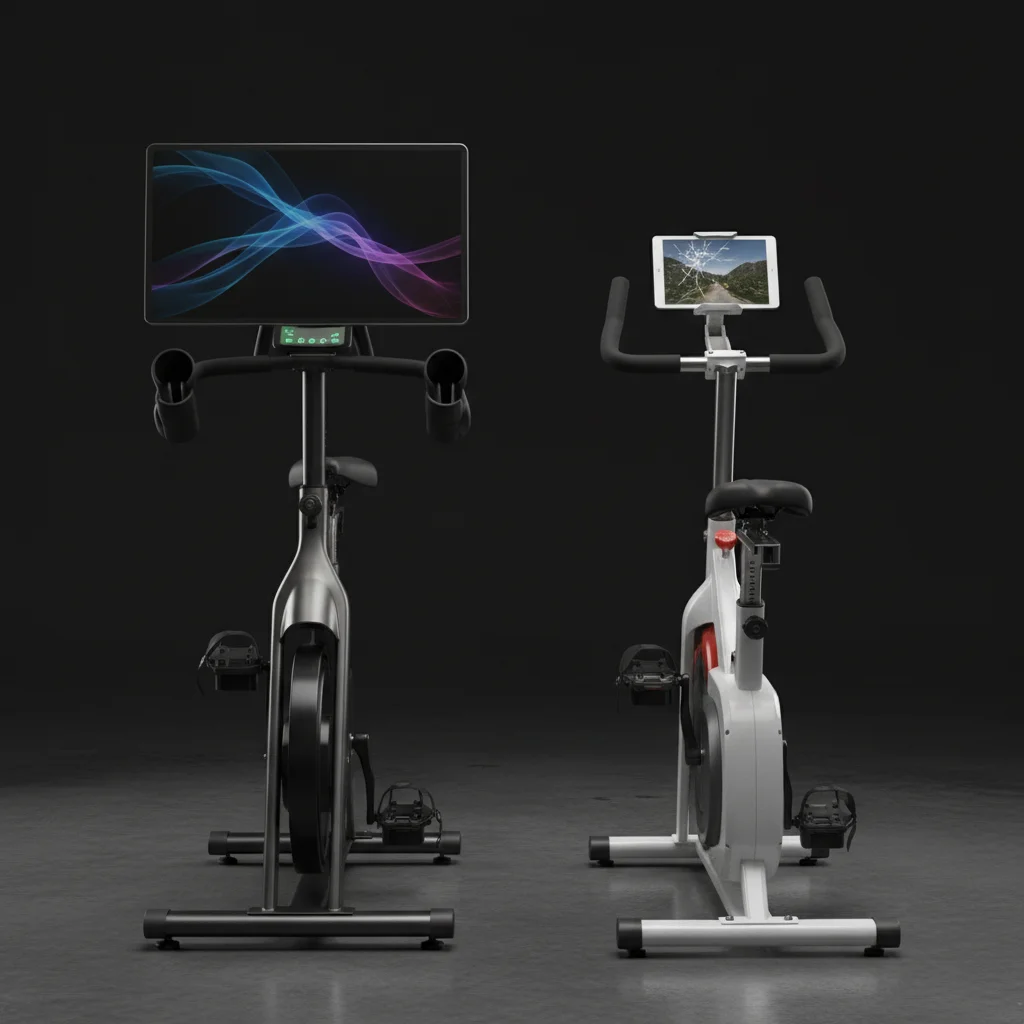
The gold standard in connected cycling. Peloton's 100 resistance levels, world-class instructors, and massive community create a riding experience that no competitor has fully matched. If you want the best and are willing to pay for it, this is the bike.
$1,445 + $44/mo All-Access Membership
Peloton Bike vs Bike+A seriously capable connected bike that undercuts Peloton on price without cutting corners on the essentials. The same screen size, solid build quality, and a growing content library make it the smart pick for budget-conscious riders.
$839 + $34.99/mo (or $399.99/yr)
See Peloton AlternativesHere is how the Peloton Bike (3rd Gen) and the Echelon EX-5s stack up on paper. We will dig into what these numbers actually mean in practice below.
| Spec | Peloton Bike (3rd Gen) | Echelon EX-5s / EX-8s |
|---|---|---|
| Price | $1,445 | $839 (EX-5s) – $1,599 (EX-8s) |
| Monthly Subscription | $44/mo (All-Access) | $34.99/mo (or $399.99/yr) |
| Screen | 21.5" HD touchscreen | 21.5" HD (EX-5s) / 24" HD (EX-8s) |
| Resistance Levels | 100 magnetic levels | 32 magnetic levels |
| Metrics Tracked | Cadence, resistance, output (watts), heart rate zones, leaderboard | Cadence, resistance, power output, leaderboard |
| Content Library | 10,000+ on-demand classes; live classes daily | Live & on-demand classes; strength, yoga, boxing |
| Off-Bike Content | Strength, yoga, meditation, stretching, running, boxing | Strength, yoga, boxing, Pilates |
| Instructor Roster | Celebrity trainers, large roster, cult following | Good instructors, smaller but growing roster |
| Community Features | Leaderboard, tags, milestones, social features, groups | Leaderboard, growing community |
| Build Quality | Premium, heavy (~135 lbs), very stable | Good, lighter (~105 lbs), some plastic components |
| Pedals | Delta-compatible clip-in (Look Delta) | Toe cages + SPD clip-in compatible |
| Warranty | 5-year frame, 1-year components | 1-year limited |
The moment you step up to both bikes, the difference in build quality is immediately obvious. That does not mean one is bad, but they are clearly targeting different price tiers.
Peloton's bike feels like a piece of premium fitness equipment from the second you unbox it. At roughly 135 pounds, this thing is heavy, and that weight translates directly into stability. There is zero wobble during standing climbs, aggressive sprints, or high-cadence efforts. The frame is welded steel, the adjustment knobs are smooth and precise, and the overall fit and finish screams quality. Peloton has had years to refine the hardware, and it shows.
The resistance mechanism uses a belt drive with magnetic resistance across 100 levels, giving you extremely fine control. During instructor callouts like "turn your resistance up by 5," you can make precise micro-adjustments that actually correspond to a noticeable but manageable increase in effort. The ride feel is smooth, quiet, and close to what you would experience on a studio bike at a high-end cycling gym.
One note: Peloton uses Look Delta-compatible pedals, which means you will need Delta-cleat cycling shoes. If you already own SPD shoes, you will either need a second pair or swap the pedals out.
The Echelon EX-5s is a well-built bike for its price, but it is noticeably lighter and uses more plastic in its construction. At around 105 pounds, it is stable enough for most riding styles, but aggressive out-of-saddle efforts can produce a slight sway that you simply do not feel on the Peloton. For the majority of seated rides and moderate-intensity climbs, the stability is perfectly fine.
The 32 magnetic resistance levels are adequate but a clear step down from Peloton's 100. Each increment is a bigger jump, which makes those fine-tuned adjustments harder to dial in. The ride feel is smooth and quiet, thanks to the magnetic resistance system, but the flywheel does not have the same weighted, premium feel as Peloton's. Think of it as the difference between a midrange and a luxury car: both get you where you need to go, but one feels more refined doing it.
On the plus side, Echelon's pedals support both toe cages (ride in regular shoes) and SPD cleats, which gives you more flexibility right out of the box.
Peloton's 21.5-inch HD touchscreen is bright, responsive, and well-calibrated. The display pivots 180 degrees so you can swivel it toward the floor for off-bike workouts like strength and yoga. Touch responsiveness is snappy with no noticeable lag when navigating menus, filtering classes, or adjusting settings mid-ride. The screen also includes a front-facing camera for video calls with other Peloton riders, though this is a feature most people do not use frequently.
The on-screen interface is clean and intuitive. Your real-time metrics (cadence, resistance, output, heart rate, and position on the leaderboard) are displayed clearly without cluttering the instructor view. After years of software iteration, Peloton's UI is the benchmark that competitors measure themselves against.
The EX-5s matches Peloton with a 21.5-inch HD touchscreen, and the upgraded EX-8s bumps that to 24 inches. Screen quality on both is solid, with good brightness and viewing angles. The touchscreen is responsive, though the software interface is not quite as polished or intuitive as Peloton's. Navigating the class library can occasionally feel a bit clunky, with some extra taps needed to find what you want.
The EX-5s screen tilts and swivels, but not with the same 180-degree range as Peloton. The EX-8s offers a larger, more immersive viewing experience that actually surpasses the Peloton Bike's screen size, which is worth considering if display real estate matters to you.
This is where the gap between Peloton and Echelon becomes most apparent. Content is the engine that keeps you coming back to a connected bike, and both platforms know it.
Peloton's content library is massive. Over 10,000 on-demand classes spanning cycling, strength, yoga, meditation, stretching, running, walking, boxing, and more. New live classes are added every single day, and the back catalog is deep enough that you could ride for years without repeating a class. Class lengths range from 5 minutes to 90 minutes, and the music selection is curated to match the energy of each ride type, from pop hits to classic rock to hip-hop theme rides.
The instructor roster is Peloton's secret weapon. Trainers like Cody Rigsby, Robin Arzon, and Alex Toussaint have genuine celebrity status with loyal followings that rival TV personalities. These are not just fitness instructors reading a script; they are entertainers who happen to be elite cycling coaches. That combination of personality, motivation, and expertise is the single biggest reason Peloton riders stay subscribed year after year.
Structured programs like "Discover Your Power Zones" and beginner ride series add a guided progression element that helps newer riders improve systematically rather than just jumping into random classes.
Echelon's content library is respectable and growing, with live and on-demand classes across cycling, strength, yoga, boxing, and Pilates. The quantity is smaller than Peloton's, but there is still more than enough to keep most riders engaged. Live classes run throughout the day, and instructors are energetic, knowledgeable, and improving in production quality.
Where Echelon falls short is in the star power and polish of its instructor lineup. The trainers are good, but they do not have the same cultural cachet or personal brands that Peloton's instructors have built. For some riders, that does not matter at all. For others, the instructor connection is the reason they clip in every morning. If you are in the latter camp, Peloton has a clear edge.
Echelon has also been expanding its content partnerships and investing in production quality. The gap has narrowed meaningfully over the past two years, and if you are coming in without prior attachment to specific Peloton instructors, Echelon's classes are genuinely enjoyable.
Peloton tracks cadence, resistance, output (measured in watts and kilojoules), heart rate (via Bluetooth chest strap or Apple Watch with GymKit), and your position on the live leaderboard. The output metric is the backbone of Peloton's performance tracking: it gives you a single, objective number that measures how hard you are working at any given moment and across an entire ride. This makes it easy to compare your performance across different rides and track improvement over time.
Heart rate zones integration is well implemented. You can set custom zones, and the on-screen display shows your current zone in real time with a color-coded overlay. Peloton also uses your data to calculate a Strive Score, which measures effort based on time spent in each heart rate zone.
Post-ride analytics are detailed. You get graphs of your output, cadence, and resistance over time, plus comparisons to your personal bests and averages. The data is exportable and integrates with Apple Health, Strava, and Fitbit.
Echelon tracks cadence, resistance, power output, and leaderboard position. The core metrics are similar to Peloton's, and for most riders, the data you need to track progress is there. Heart rate monitoring is supported via Bluetooth heart rate monitors.
The main difference is in the depth and polish of the analytics. Echelon's post-ride data is more basic, and the historical tracking is not as robust as Peloton's. The leaderboard is functional but does not have the same level of social integration (tags, groups, high-fives) that makes Peloton's feel like a live competition. For data-driven riders who obsess over performance trends, Peloton's analytics platform is a clear step ahead. For riders who just want to see their cadence, output, and leaderboard rank, Echelon covers the basics.
Community is arguably Peloton's greatest competitive advantage. The leaderboard is not just a list of names; it is a real-time competition that pushes you harder than you would push yourself. Tags let you join groups based on interests, location, or goals (like #PelotonMoms or #PowerZonePack), and you can filter the leaderboard to compete directly against people in your tags. Milestones (100 rides, 500 rides, etc.) are celebrated by instructors during live classes with on-screen shout-outs, which creates a surprisingly powerful emotional connection.
High-fives during rides, the ability to follow friends, and group workout sessions add a social layer that transforms indoor cycling from a solitary activity into a shared experience. The Peloton subreddit, Facebook groups, and unofficial communities are enormous. There is a genuine culture around Peloton that extends well beyond the bike itself.
Echelon has a leaderboard and a growing community, but it is significantly smaller than Peloton's. The social features are more limited. You can compete on the leaderboard and connect with other riders, but the depth of engagement (tags, milestones, shout-outs, groups) is not on the same level. For riders who prefer a quieter, more personal experience and do not need the social motivation, this may actually be a positive. For riders who thrive on community energy and competition, Peloton is the obvious choice.
That said, Echelon's community is active and enthusiastic. The smaller size can actually feel more welcoming to newcomers who might be intimidated by Peloton's massive, sometimes intense, leaderboard culture. It is a different vibe, not necessarily a worse one.
Let us break down the total cost of ownership, because the sticker price is only part of the picture.
| Cost Component | Peloton Bike (3rd Gen) | Echelon EX-5s |
|---|---|---|
| Hardware | $1,445 | $839 |
| Cycling Shoes | ~$50–$125 (Look Delta) | $0 (toe cages) or ~$50 (SPD shoes) |
| Subscription (36 mo) | $1,584 ($44/mo) | $1,260 ($34.99/mo) or $1,200 (annual plan) |
| Delivery & Setup | Included (Peloton delivery) | Free shipping (self-assembly) |
| 3-Year Total | $3,079–$3,154 | $2,039–$2,149 |
| Monthly Equivalent | ~$86/mo | ~$58/mo |
The difference over three years comes out to roughly $900 to $1,100. That is not trivial, but it is not astronomical either. To put it in perspective, it is about $25 to $30 more per month for the Peloton experience. Whether that premium is "worth it" depends entirely on how much you value the instructor quality, community size, content depth, and build quality differences outlined above.
For context, a single SoulCycle class costs $30 to $40 per session. If you ride four times a week, even the Peloton at $86/month is a steal compared to studio cycling. Both bikes replace a gym membership and a boutique studio habit at a fraction of the cost. The Echelon is simply the more aggressive value play.
It is also worth noting that Peloton frequently offers financing at 0% APR, and Echelon often runs sales that drop the EX-5s well below the $839 list price, especially on Amazon. Check current pricing before you buy.
After months of riding both bikes, here is the bottom line:
Peloton is the better bike by virtually every measurable standard. The hardware is more refined, the resistance control is superior, the content library is deeper, the instructors are in a different league, and the community is unmatched in connected fitness. If your budget allows it and you value the complete package, the Peloton Bike (3rd Gen) remains the gold standard for indoor cycling at home.
Echelon is the smarter buy for many riders. Here is the thing: most of those Peloton advantages, while real, are incremental rather than transformational. The Echelon EX-5s delivers a genuinely good connected cycling experience, with a solid bike, live and on-demand classes, and a functional leaderboard, at roughly $1,000 less over three years. For riders who want a great workout without paying the Peloton premium, Echelon is the clear value winner.
Our recommendation: If community, instructor personality, and a polished ecosystem are what get you on the bike every day, go with Peloton. The premium pays for itself if it keeps you riding consistently. If you are a self-motivated rider who clips in regardless of who is on screen and wants to keep more money in your pocket, the Echelon EX-5s is an excellent choice that will not leave you feeling like you settled.
Both bikes are legitimate gym replacements that deliver real results. The one that gets you riding consistently is the one worth buying.
Want more options? Check out our best exercise bikes roundup or see how Peloton compares to NordicTrack.
The Peloton Bike is worth the premium if you value best-in-class instructors, a massive community with leaderboard competition, and the most polished software experience in connected fitness. The cult-like community and celebrity trainers create a level of motivation that is hard to replicate. However, if you are primarily looking for a solid cardio workout with live and on-demand classes and want to save several hundred dollars upfront plus $10 per month on the subscription, Echelon delivers a very comparable riding experience at a lower total cost.
Both bikes can technically be ridden without an active subscription for a basic free-ride experience where you pedal without guided content. However, you lose access to all on-demand and live classes, structured programs, leaderboard features, and detailed performance tracking. For Peloton, you get a limited selection of free classes without a membership. For Echelon, the bike becomes a standard stationary bike with basic metric display. Since the software and content are the primary reasons to buy either bike, most riders will want an active subscription.
Peloton offers 100 magnetic resistance levels compared to Echelon's 32 levels. In practice, this means Peloton provides much finer incremental control over your effort. You can make small, precise adjustments during a ride, which is especially useful during instructor callouts and interval training. Echelon's 32 levels still cover a wide range from very easy to extremely challenging, but each jump between levels is more noticeable. For most casual to intermediate riders, 32 levels is perfectly adequate. Competitive riders and those who want granular control will prefer Peloton's 100-level system.
Both bikes are excellent for beginners, but they suit different types of new riders. Peloton is best for beginners who are motivated by community and instructor personality. The beginner-friendly programs are well structured, the instructors are encouraging, and the milestone system keeps you coming back. Echelon is best for budget-conscious beginners who want to test whether indoor cycling is right for them without a large financial commitment. The lower upfront cost and cheaper subscription reduce the risk if you discover cycling is not your thing after a few months.
Yes, both platforms offer extensive off-bike content. Peloton's All-Access membership includes over 10,000 on-demand classes spanning strength training, yoga, meditation, stretching, running, walking, boxing, and more. Echelon's membership includes strength, yoga, boxing, Pilates, and rowing classes (if you own their rower). Peloton has a significantly larger content library overall and more variety in class lengths and music genres. Both platforms add new classes daily, but Peloton's content depth is noticeably larger.
Is the Bike+ upgrade worth the extra cost? We break down every difference between Peloton's two bikes to help you decide.
Our complete ranking of the best exercise bikes at every price point, from budget spin bikes to premium connected platforms.
Love connected cycling but not the Peloton price? Here are the best alternatives at every budget in 2026.