Best Of
Best Treadmills for Home Gyms (2026)
Our ranked list of the best treadmills across every budget, from budget-friendly to premium connected models.
Home → Comparisons → Peloton vs NordicTrack
Last updated: March 2026
Peloton and NordicTrack are the two biggest names in connected treadmills, and choosing between them is one of the most common dilemmas for home gym buyers. Both offer large touchscreens, immersive content platforms, and solid build quality — but they take meaningfully different approaches to the at-home running experience, and the price gap between them is not small.
We dug into the specs, tested the content platforms, and compared the long-term costs so you can figure out which one actually makes sense for your goals and budget. Here is how the Peloton Tread and NordicTrack Commercial 2450 stack up in 2026.
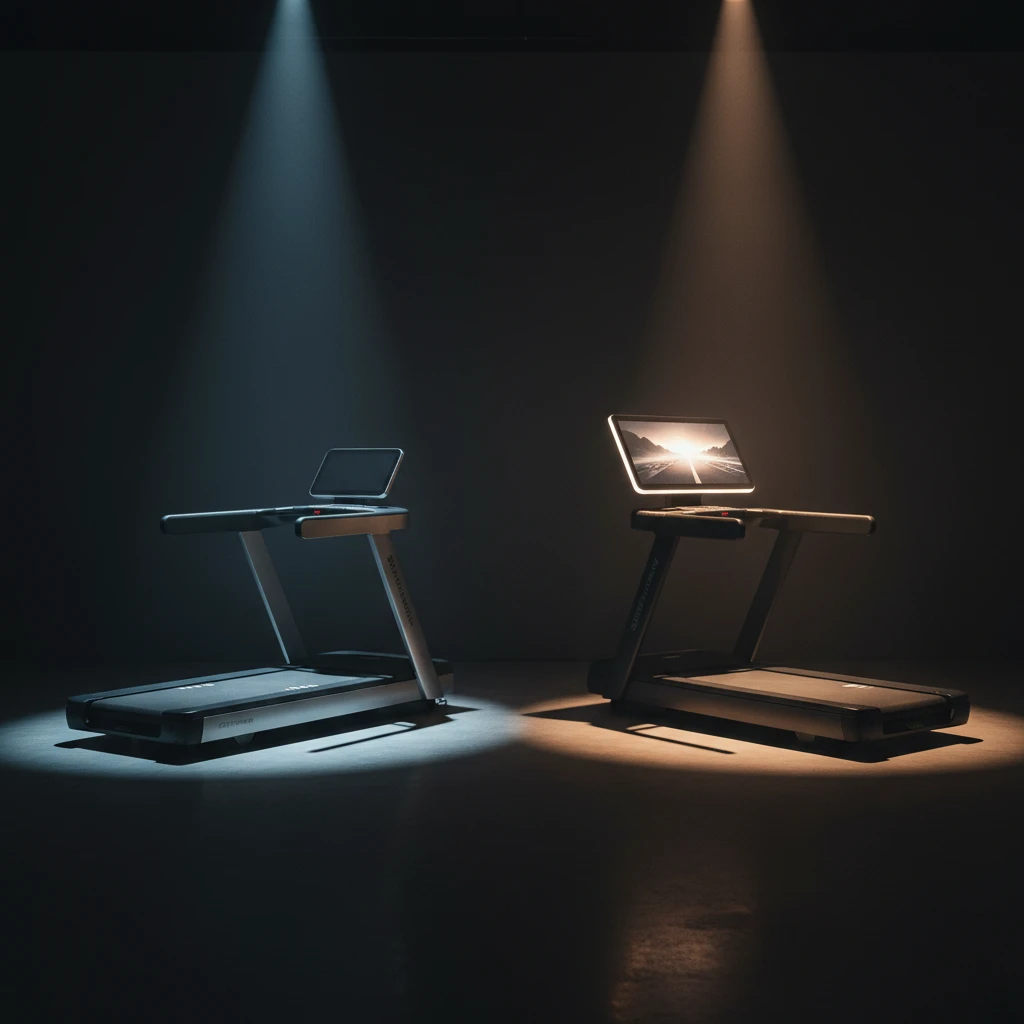
Best for content & classes. Unmatched live class experience, leaderboard community, and the largest screen in the category.
Best value. Nearly identical hardware for $1,000 less, plus decline training and iFIT outdoor routes.
Budget pick. Smaller 14" screen but still solid hardware and full iFIT access at a lower entry price.
Numbers do not lie. Here is a side-by-side look at the specs that matter most.
| Spec | Peloton Tread | NordicTrack Commercial 2450 |
|---|---|---|
| Price | $3,495 | $2,499 |
| Screen | 23.8" HD touchscreen | 22" HD touchscreen |
| Belt Size | 59" x 20" | 60" x 22" |
| Max Speed | 12.5 mph | 12 mph |
| Incline | 0–15% | 0–15% |
| Decline | None | -3% |
| Weight Capacity | 300 lbs | 300 lbs |
| Dimensions | 72" L x 33" W x 72" H | 81" L x 39" W x 59" H |
| Foldable | No | Yes (SpaceSaver design) |
| Monthly Fee | $44/mo (Peloton All-Access) | $39/mo (iFIT Family) |
| Frame Warranty | 5 years | 10 years |
| Parts Warranty | 5 years | 2 years |
| Labor Warranty | 1 year | 1 year |
Both treadmills feel premium the moment you step on them, but they are designed with different priorities in mind.
The Peloton Tread is a striking piece of equipment. Its carbon steel frame, rubberized slat belt, and minimalist aesthetic give it a boutique studio look. The build quality is genuinely excellent — the frame feels rock-solid, and there is virtually no flex or wobble even at high speeds. The trade-off is that it is non-folding, which means it takes up a permanent 72" x 33" footprint in your space. At 290 lbs assembled, this thing is not going anywhere once you set it up.
The NordicTrack Commercial 2450 takes a more practical approach. The frame is robust and well-built, though it uses a traditional belt rather than Peloton's slat design. Where it really wins on design is the SpaceSaver fold-up feature — you can fold the deck vertically after your workout to reclaim floor space. That is a big deal if you are putting this in a shared room or a smaller home gym. It is larger when unfolded (81" x 39"), but the folding mechanism is smooth and genuinely useful.
Edge: Peloton for raw build quality and aesthetics. NordicTrack for practical design and space savings.
This is where these two machines start to feel genuinely different.
The Peloton Tread uses a slat belt system, which provides a unique running feel. The individual rubber slats absorb impact more evenly than a traditional belt, and the result is a running surface that feels cushioned without being mushy. Serious runners will appreciate the 12.5 mph top speed and the smooth, consistent ride at faster paces. The speed and incline controls are operated via physical knobs on the side rails — a design choice that is more intuitive and responsive than touchscreen controls during an intense run.
The NordicTrack Commercial 2450 uses a traditional belt over a cushioned deck, which is perfectly comfortable for most runners. The belt is actually slightly larger at 60" x 22" compared to Peloton's 59" x 20" — those extra inches matter if you are tall or have a wider stride. The standout feature here is the -3% decline capability, which lets you simulate downhill running. That is something you simply cannot do on the Peloton, and it is valuable for runners training for outdoor races with varied terrain.
The top speed on the NordicTrack is 12 mph, which is half a mile per hour slower than the Peloton. For most people, that difference is irrelevant. You would need to be running a sub-5:00 mile to even approach 12 mph. But if you are an elite runner who does sprint intervals, the Peloton gives you a bit more headroom.
Edge: A tie, honestly. Peloton's slat belt feels premium and handles high speeds well. NordicTrack's decline feature and wider belt make it slightly more versatile for serious training.
Content is arguably the biggest differentiator between these two treadmills, and it is where your personal preferences will matter most.
Peloton's content platform is the gold standard for live fitness classes. The 23.8" touchscreen is the largest in the category, and it is gorgeous — bright, responsive, and perfectly angled for running. The class library is enormous, covering running, walking, bootcamp, stretching, and strength workouts. Live classes run daily with energetic instructors and real-time leaderboards that let you compete with thousands of other users.
The community aspect is where Peloton really shines. The leaderboard, milestone celebrations, and social features create a sense of accountability that genuinely motivates people to show up consistently. If you thrive on group energy and structured classes, nothing else comes close.
NordicTrack's iFIT platform takes a fundamentally different approach. Instead of studio-style classes, iFIT focuses on immersive outdoor experiences. Trainers lead runs through real locations around the world — from the streets of Paris to mountain trails in New Zealand — while the treadmill automatically adjusts your incline and decline to match the terrain. It is a genuinely cool experience that makes indoor running feel less monotonous.
iFIT also offers structured training programs, studio classes, and personalized recommendations. The 22" screen is slightly smaller than Peloton's but still excellent. Where iFIT falls short is the live class experience and community features — it just does not match Peloton's energy in that department.
Edge: Peloton for live classes and community. iFIT for immersive outdoor routes and automatic machine adjustments. Both are excellent; it depends on what motivates you.
Let us talk about total cost of ownership, because the sticker price is only part of the story.
The Peloton Tread starts at $3,495 for the hardware. Add the required $44/month All-Access membership, and you are looking at the following costs over time:
The NordicTrack Commercial 2450 starts at $2,499. The iFIT Family membership is $39/month:
After three years of use, the NordicTrack saves you about $1,176 compared to the Peloton. That is a significant difference — roughly equivalent to a year's worth of gym membership on top.
It is worth noting that both treadmills offer financing options. Peloton offers 0% APR for up to 43 months, and NordicTrack provides similar financing through various retail partners. Neither machine requires a subscription to function as a basic treadmill, but losing the content platform defeats much of the purpose of buying a connected treadmill in the first place.
Edge: NordicTrack, clearly. You save about $1,000 upfront and $60/year on subscriptions.
Warranty coverage differs between the two, and neither is a clear-cut winner.
The Peloton Tread comes with a 5-year warranty on the frame, 5 years on parts, and 1 year on labor. That is a solid, straightforward warranty. Peloton's customer support has improved significantly since its rocky patch in 2021-2022, and most users now report reasonable response times and helpful service.
The NordicTrack Commercial 2450 offers a 10-year frame warranty, which is double Peloton's coverage. However, the parts warranty is only 2 years (compared to Peloton's 5), and labor is also 1 year. NordicTrack's customer support reputation is more mixed — some users report longer wait times and less consistent service quality.
In practice, the frame is the least likely component to fail on either treadmill. The parts warranty matters more for things like the motor, belt, electronics, and touchscreen. On that front, Peloton's 5-year parts warranty gives you more peace of mind.
Edge: Peloton for overall warranty value, especially the 5-year parts coverage.
Both the Peloton Tread and the NordicTrack Commercial 2450 are genuinely excellent treadmills. You will not regret buying either one. But they are designed for different priorities, and the right choice depends on what matters most to you.
Choose the Peloton Tread if content is king for you. If live classes, instructor energy, leaderboards, and the Peloton community are what will keep you running consistently, the premium price is justified. The hardware is outstanding, the screen is the best in the business, and the overall experience is incredibly polished. Just be prepared to pay for it — both upfront and every month.
Choose the NordicTrack Commercial 2450 if you want the best bang for your buck. You get nearly identical hardware specs, a foldable design, decline training, and iFIT's immersive outdoor routes — all for about $1,000 less at the register and $60 less per year on subscriptions. If you are a runner who cares more about training versatility than live class hype, the NordicTrack is the smarter buy.
For most people, we recommend the NordicTrack Commercial 2450. The value proposition is simply too strong to ignore. You get 90% of the Peloton experience at a significantly lower price, with the added bonus of decline training and a foldable frame. But if you are a die-hard Peloton fan who lives for those leaderboards, the Tread delivers an experience that nothing else can replicate.
If you are deeply invested in the Peloton content ecosystem and value the community experience, the Peloton Tread can be worth the premium. The build quality is excellent, the 23.8" screen is the best in class, and the live classes are unmatched. However, if you primarily want a solid running machine and are less interested in guided content, the NordicTrack Commercial 2450 delivers comparable hardware for about $1,000 less.
Yes, you can use the NordicTrack Commercial 2450 without an iFIT subscription. You will still be able to run manually using basic speed and incline controls. However, you will lose access to interactive workouts, trainer-led classes, automatic incline adjustment, and Google Maps routes. The touchscreen functionality becomes quite limited without iFIT. It works, but you are leaving a lot of the machine's value on the table.
For pure running performance, it is close. The NordicTrack Commercial 2450 has a slight edge thanks to its wider 22" belt, decline capability for downhill training, and SpaceSaver fold-up design. The Peloton Tread counters with a slightly higher top speed of 12.5 mph and its slat belt system that feels exceptionally smooth at high speeds. Both are excellent running machines. Serious runners who want decline training should lean toward NordicTrack, while those who prefer a premium running surface may prefer Peloton.
Peloton is widely considered the leader in fitness content. Its library features thousands of live and on-demand classes with high-energy instructors and a massive community with real-time leaderboards. NordicTrack's iFIT platform takes a different approach, offering Google Maps-powered outdoor routes, trainer-led programs, and automatic machine adjustments. Peloton wins for the group fitness class experience, while iFIT is stronger for immersive outdoor simulation and structured training programs.
Yes. The NordicTrack Commercial 1750 ($1,799) is a strong budget alternative that still includes a 14" touchscreen and iFIT compatibility. The Sole F80 (around $1,499) is another popular option with no required subscription. For even more savings, the Horizon 7.0 AT (around $999) offers solid running performance without any monthly fees. Check our best treadmills guide for the full ranked list.
Our ranked list of the best treadmills across every budget, from budget-friendly to premium connected models.
Love the connected fitness concept but not the Peloton price? Here are the best alternatives for bikes and treads.
Three smart home gyms, three different approaches. Here is which one is actually worth your money.