Best Of
Best Adjustable Dumbbells 2026
Our complete ranking of the best adjustable dumbbells for every budget, from budget selectorized sets to premium options.
Last updated: March 2026
PowerBlock Elite EXP and Bowflex SelectTech 552 are the two most popular adjustable dumbbells on the market, and for good reason. Both replace an entire rack of fixed dumbbells in a fraction of the space, both adjust in seconds, and both have been around long enough to earn serious reputations. But they take fundamentally different approaches to the same problem, and the right choice depends on what matters most to you.
We have tested both sets extensively in our home gym, running them through everything from light isolation work to heavy compound movements. Here is our honest, side-by-side breakdown to help you decide which pair deserves a spot in your setup.
The most compact and expandable adjustable dumbbell you can buy. Steel construction, a 10-year warranty, and the ability to grow from 50 lbs all the way to 90 lbs per hand make it the long-term choice for dedicated home gym users.
$400–$500 (50 lb set) • Expandable to 70/90 lbs
Check Price on AmazonThe easiest adjustable dumbbell to use, period. The twist-dial mechanism is intuitive, the shape feels like a traditional dumbbell, and the 5-52.5 lb range covers the vast majority of home workouts. Ideal if you want something that just works out of the box.
$429 (pair)
Check Price at BowflexHere is how these two adjustable dumbbells stack up on paper. We will dig into what these numbers actually mean in practice below.
| Spec | PowerBlock Elite EXP | Bowflex SelectTech 552 |
|---|---|---|
| Price | $400–$500 (50 lb set) | $429 (pair) |
| Weight Range | 5–50 lbs (expandable to 70 or 90 lbs) | 5–52.5 lbs |
| Weight Increments | 2.5 lb increments (with adder weights) | 2.5 lb increments up to 25 lbs, then 5 lb increments |
| Adjustment Mechanism | Magnetic pin selector | Twist-dial |
| Shape | Compact block/cube | Long, traditional dumbbell |
| Construction | Steel with urethane coating | Steel plates with plastic housing and dial |
| Dimensions (per dumbbell) | 12" L x 6.5" W x 6.5" H | 15.75" L x 8" W x 9" H |
| Expandable | Yes (to 70 lbs or 90 lbs with kits) | No (separate 1090 model goes to 90 lbs) |
| Drop Safe | More durable, but not recommended | No — plastic components can break |
| Warranty | 10-year limited (residential) | 2-year limited |
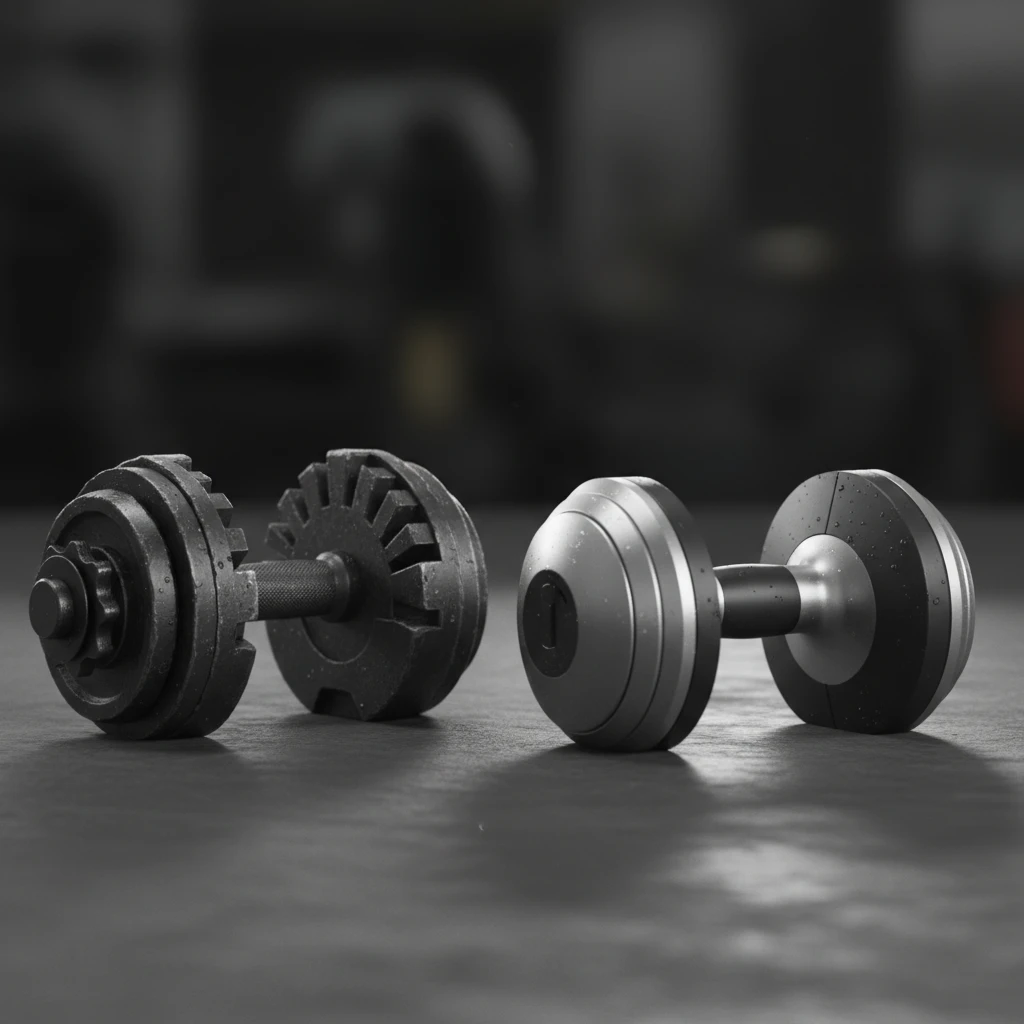
These two dumbbells could not look more different sitting side by side, and that difference is not just cosmetic. It affects how they feel in your hand and how they hold up over time.
PowerBlock takes a completely unconventional approach to dumbbell design. Instead of a bar with weights on each end, you get a rectangular block that nests inside a series of weighted shells. The result is an incredibly compact package that looks more like a small toolbox than a dumbbell. The entire unit is steel with a urethane coating on the handles, and it feels built to survive a decade of hard use.
The trade-off is that the block shape puts your hand inside a cage-like frame. Your wrist can contact the inner walls during certain movements, and the overall feel is distinctly different from any traditional dumbbell. Some exercises, like hammer curls and overhead tricep extensions, feel perfectly natural. Others, like dumbbell flyes, can feel a bit awkward until you adapt your grip and movement pattern.
Bowflex went the opposite direction with a design that mimics a traditional dumbbell as closely as possible. The 552 has a central handle with weight plates on each end, connected by a twist-dial mechanism at each end. It looks and feels familiar from the first rep, which is a big deal if you have spent years training with standard dumbbells.
The downside is that the 552 is noticeably longer and bulkier than the PowerBlock, especially at lighter weights. Because all the internal plates remain inside the cradle (you are essentially selecting which ones lock onto the bar), the dumbbell always has the same external shell. At 5 lbs, you are still holding a 15.75-inch-long dumbbell, which can feel odd. The plastic housing around the dial mechanism is the other concern. It works well when treated carefully, but it is not as confidence-inspiring as PowerBlock's all-steel construction.
The base set covers 5 to 50 lbs per dumbbell, which handles the vast majority of home gym exercises. But the real selling point is expandability. You can purchase add-on kits to push the range to 70 lbs or even 90 lbs per hand, all using the same base unit. This means you buy once and grow as you get stronger, without replacing your dumbbells entirely. For someone who is just starting out but plans to get seriously strong over the next few years, this is a significant advantage.
The 552 covers 5 to 52.5 lbs per dumbbell, which is slightly more than the base PowerBlock set. The 2.5 lb increments up to 25 lbs are great for progressive overload on smaller muscle groups like shoulders and biceps. However, the 552 is a closed system. There is no way to expand it beyond 52.5 lbs. If you outgrow the weight, your only option is to buy the entirely separate Bowflex SelectTech 1090, which costs $599 and covers 10 to 90 lbs. That means you could end up owning two separate dumbbell systems, which defeats the space-saving purpose.
How you change the weight between sets matters more than most people realize, especially if you do supersets, drop sets, or time-sensitive circuits.
PowerBlock uses a magnetic pin selector system. You pull out a pin, move it to the desired weight slot, and push it back in. The magnets hold the pin securely in place. Weight changes take roughly 5 to 10 seconds once you get the hang of it. The system is straightforward and reliable, with no moving mechanical parts that can wear out or break. The one downside is that you need to set the dumbbell in its cradle to change the weight. You cannot adjust on the fly, but that is true of all selectorized dumbbells.
Bowflex uses a twist-dial at each end of the dumbbell. You rotate the dial to your desired weight, and the internal locking mechanism engages the correct number of plates. Weight changes are fast, about 3 to 5 seconds, and feel very intuitive. The dial clicks into each weight setting with satisfying precision. It is arguably the most user-friendly adjustment mechanism on the market.
The concern with the twist-dial is long-term durability. The mechanism involves plastic components and small interlocking parts. Over time, some users report the dial becoming less precise or harder to turn. This is not a universal issue, but it is worth noting that the mechanical complexity of the dial gives it more potential failure points compared to PowerBlock's simple pin system.
The comfort factor is where PowerBlock loses some people. The rectangular shape means your hand sits inside a cage-like frame, and the weight distribution feels different from a traditional dumbbell. Your wrist may brush against the inner rails during pressing movements, and exercises like wrist curls or certain angles of flyes can feel restricted. PowerBlock users generally say it takes two to three weeks to fully adapt, after which the shape stops being noticeable.
On the positive side, the compact design keeps the weight close to your hand, which actually makes some exercises feel more stable. The center of gravity is tighter than a long-bar dumbbell, and the urethane-coated handle provides a comfortable, secure grip.
The Bowflex feels like a dumbbell from the moment you pick it up. The bar-style handle with weight on each end is exactly what your body expects, and there is virtually no learning curve. This familiarity is a genuine advantage for anyone transitioning from a commercial gym, because every exercise feels the way it should from rep one.
The downside is the length. At nearly 16 inches long, the 552 can feel unwieldy during certain exercises, particularly anything where two dumbbells come close together, like dumbbell presses or hammer curls. The weight distribution is also spread further from your hand compared to the PowerBlock, which can create a slight lever effect at heavier weights that taxes your forearms and wrists more than necessary.
This is PowerBlock's biggest win. The compact block design means a pair of 50 lb PowerBlocks takes up roughly the same space as a shoebox on each side. The cradle (sold separately or bundled) has a small footprint and can tuck into a corner, under a desk, or on a shelf. If you are building a home gym in a tight space, PowerBlock gives you the best weight-to-footprint ratio of any adjustable dumbbell on the market.
The Bowflex set requires more space. The included cradle or storage tray is wider and longer to accommodate the dumbbell's 15.75-inch length, and you need enough clearance to twist the dials on each end. It is still far more space-efficient than a full dumbbell rack, but side by side with the PowerBlock, the difference is noticeable. For a dedicated home gym room, this is rarely an issue. For a corner of a living room or bedroom, the PowerBlock's compactness matters.
Both of these dumbbells fall in a similar price range at the base level, but the long-term value story is quite different.
| Cost Scenario | PowerBlock Elite EXP | Bowflex SelectTech |
|---|---|---|
| Base Set (up to ~50 lbs) | $400–$500 | $429 |
| Expand to 70 lbs | +$109 (add-on kit) | Not available |
| Expand to 90 lbs | +$219 total (staged kits) | $599 (separate SelectTech 1090) |
| Total for 90 lb capability | ~$620–$720 | $1,028 (552 + 1090) |
| Warranty | 10 years | 2 years |
| Equivalent Fixed Dumbbells | Replaces ~$1,200+ in fixed dumbbells | Replaces ~$1,200+ in fixed dumbbells |
At the base level, both offer excellent value compared to buying individual fixed dumbbells. A full set of fixed dumbbells from 5 to 50 lbs would cost well over $1,000 and require a large dumbbell rack.
Where the value equation shifts is if you expect to need more than 50 lbs down the road. PowerBlock's expansion kits let you grow incrementally at a reasonable cost, while Bowflex forces you to buy an entirely separate product. If you are investing for the long term, PowerBlock's expandable design saves you money and space.
The warranty difference is also significant. PowerBlock's 10-year residential warranty is five times longer than Bowflex's 2-year coverage. Over a decade of use, that peace of mind has real value.
After extensive testing with both sets, here is the bottom line:
PowerBlock Elite EXP is the better long-term investment for anyone serious about building a home gym. The steel construction, 10-year warranty, and expandability to 90 lbs mean you are buying a dumbbell set that will grow with you for a decade or more. The compact design is also unbeatable if space is at a premium. Yes, the block shape takes getting used to, but most lifters adapt within a few weeks and stop noticing it entirely.
Bowflex SelectTech 552 is the better pick for ease of use and comfort. If you want an adjustable dumbbell that feels like a regular dumbbell from day one, the Bowflex is it. The twist-dial is the most intuitive adjustment mechanism on the market, and the familiar shape means zero learning curve. It is an excellent choice for general fitness enthusiasts, home workout beginners, or anyone who simply does not want to think about their equipment and just wants to lift.
If you know you will eventually need more than 50 lbs, the math clearly favors PowerBlock. Expanding the Elite EXP to 90 lbs costs roughly $220 in add-on kits, while getting Bowflex to 90 lbs means buying the entirely separate SelectTech 1090 for $599 on top of what you already spent. That is a meaningful difference.
For most home gym users who train consistently and plan to get stronger over time, we recommend the PowerBlock Elite EXP. For casual fitness users who want the simplest, most familiar experience and do not plan to lift above 50 lbs per hand, the Bowflex SelectTech 552 is the easier choice.
PowerBlock dumbbells are worth it if you prioritize durability, compactness, and long-term expandability. The steel construction and 10-year warranty mean they will last for years, and the ability to expand from 50 lbs to 70 or even 90 lbs per hand makes them a future-proof investment. The block shape does take some getting used to, but most users adapt within a few weeks. For serious lifters building a home gym, PowerBlocks are one of the best adjustable dumbbell investments you can make.
No, you should not drop Bowflex SelectTech dumbbells. The twist-dial mechanism relies on plastic internal components that can crack or break if the dumbbells are dropped, even from a modest height. Bowflex explicitly warns against dropping them in the user manual, and damage from drops is not covered under warranty. If you tend to drop dumbbells at the end of heavy sets, PowerBlock or traditional fixed dumbbells are a safer choice.
PowerBlock is the better choice for heavy lifting. The Elite EXP starts at 5-50 lbs but can be expanded to 70 lbs or 90 lbs per hand with add-on kits, giving you significantly more room to grow. The steel construction also handles heavier loads more confidently. Bowflex SelectTech 552 maxes out at 52.5 lbs with no expansion option. Bowflex does offer the SelectTech 1090 model that goes up to 90 lbs, but it is a separate, more expensive purchase at $599 and cannot be upgraded from the 552.
With proper care, Bowflex SelectTech dumbbells can last 5-10 years or more. The key is never dropping them and always placing them back in the cradle gently. The most common failure points are the internal plastic selector plates and the twist-dial mechanism. Some users report issues after 2-3 years of heavy use, while others have had theirs for over a decade without problems. The 2-year warranty is relatively short, so longevity depends heavily on how carefully you handle them.
For most home gym users, yes. A single pair of adjustable dumbbells like PowerBlock Elite EXP or Bowflex SelectTech 552 replaces 15-16 pairs of fixed dumbbells, saving hundreds of dollars and significant floor space. The main trade-off is transition time between weights, which is slower than grabbing a different pair off a rack. For supersets and rapid weight changes, fixed dumbbells are still faster. But for general strength training, adjustable dumbbells are a practical and space-efficient replacement.
Our complete ranking of the best adjustable dumbbells for every budget, from budget selectorized sets to premium options.
How to build a complete, effective home gym for under $1,000. Every piece of equipment you need, and nothing you do not.
You do not need to spend a fortune to train effectively at home. Here is the smartest way to build a home gym on a tight budget.