Best Of
Best Power Racks 2026
Our complete ranking of the best power racks for home gyms, from budget-friendly options to full commercial-grade setups.
Last updated: March 2026
REP Fitness makes two of the most popular power racks in the home gym world, and they share the same DNA: 3x3 11-gauge steel uprights, 5/8-inch holes on Westside spacing, and a 1,000 lb weight capacity. On paper, they look almost identical. So why does the PR-5000 cost nearly $280 more than the PR-4000?
The answer comes down to expandability, fit and finish, and how far you plan to take your home gym build. We have trained in both racks extensively, loaded them up with accessories, and put them through every scenario a serious home gym lifter would encounter. Here is our honest comparison to help you decide which one deserves your money.
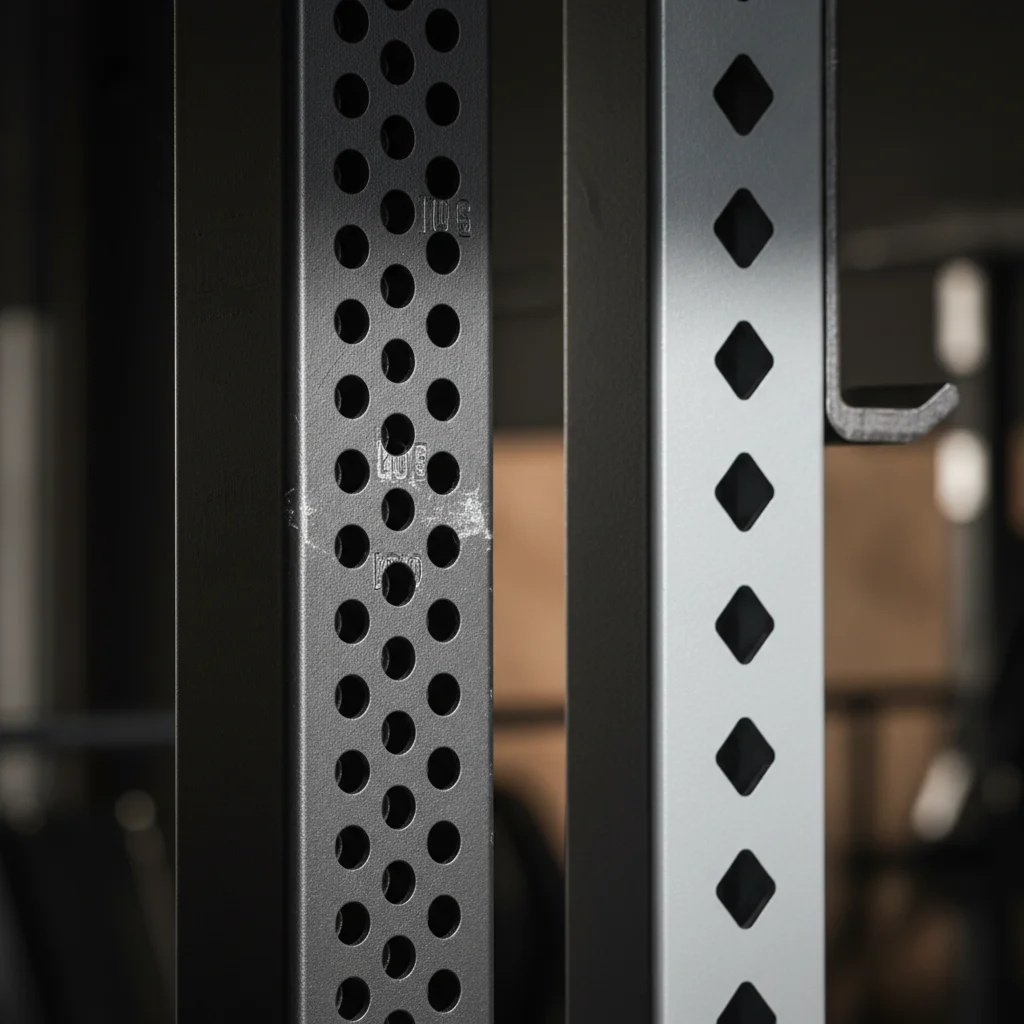
The PR-4000 delivers 90% of the PR-5000 experience at a significantly lower price. Same steel, same hole spacing, same weight capacity. For lifters who want a rock-solid rack without paying for extras they may never use, this is the smarter buy.
From $621 (base rack)
Check Price at REPIf you are planning a fully loaded rack with a lat pulldown, plate storage, dip station, and more, the PR-5000's 4-way compatibility and extra attachment points make it the better foundation. The included sandwich J-cups and numbered holes are genuine quality-of-life upgrades.
From $899 (base rack)
Check Price at REPHere is how these two racks stack up on paper. We will dig into what these numbers actually mean in practice below.
| Spec | REP PR-4000 | REP PR-5000 |
|---|---|---|
| Price (Base) | $621 | $899 |
| Configured Price | ~$1,000+ | ~$1,700+ |
| Uprights | 3" x 3" 11-gauge steel | 3" x 3" 11-gauge steel |
| Hole Size & Spacing | 5/8" holes, Westside spacing | 5/8" holes, Westside spacing |
| Hole Compatibility | 2-way (inside faces only) | 4-way (front, back, left, right) |
| Numbered Holes | No | Yes (laser-etched) |
| External Depth | 47" | 47" or 30" |
| Internal Depth | 24" | 24" or 16" (short depth option) |
| Weight Capacity | 1,000 lbs | 1,000 lbs |
| Rack Weight | ~135 lbs | ~180 lbs |
| J-Cups Included | Standard J-cups | Sandwich J-cups |
| Colors | Multiple powder coat options | Multiple powder coat + exclusive colors |
| Accessory Compatibility | Most 3x3 5/8" accessories | Most 3x3 5/8" accessories + 4-way exclusives |
Both racks use the same 3x3 11-gauge steel tubing, so the core structural integrity is identical. You are getting a 1,000 lb rated rack in either case, which is more than enough for the vast majority of home gym lifters. Even if you are squatting 500+ lbs, neither rack is going to flex, wobble, or give you any reason to worry.
The PR-4000's build quality is excellent for the price. The welds are clean, the powder coat finish is durable, and the overall fit and finish are a clear step above budget racks from brands like Titan or Hulkfit. The standard J-cups that come with the rack are functional but basic. They have plastic liners to protect your barbell knurling, but they are not in the same league as the sandwich-style J-cups that come with the PR-5000.
One thing to note: the PR-4000's uprights only have holes drilled on the inside-facing surfaces. This is perfectly fine for a standard rack setup, but it does limit where you can mount external accessories. If you want to bolt plate storage pegs or other accessories to the outside of the uprights, you will need to drill your own holes or find creative workarounds.
The PR-5000 is a noticeable step up in the details department. The laser-etched numbered holes are the first thing you will appreciate when setting up safeties or J-cups. No more counting holes from the bottom to make sure both sides are even. It sounds like a small thing, but when you are adjusting rack height between exercises in the middle of a workout, it saves real time and eliminates guesswork.
The included sandwich J-cups are a genuine upgrade. They grip the barbell with UHMW plastic on both sides, providing a more secure hold and better knurling protection than standard J-cups. These alone would cost $50-$70 if purchased separately. The 4-way hole pattern also gives the rack a more robust, overbuilt feel. At roughly 180 lbs for the base unit versus the PR-4000's 135 lbs, the PR-5000 is simply a heavier, more substantial piece of equipment.
The PR-4000 comes in one depth configuration: 47 inches external, 24 inches internal. This is a standard full-size rack depth that provides plenty of room for squatting and benching inside the rack. It is available in multiple height options to accommodate different ceiling heights, including an 80-inch and a 93-inch version. For most garage gyms with standard 8-foot ceilings, the 80-inch version is the safe bet.
The PR-5000 gives you a choice that the PR-4000 does not: a 30-inch external depth option (16-inch internal). This short-depth configuration is a game-changer for lifters with tighter spaces. You lose the ability to squat inside the rack comfortably, but you can still bench inside it and use it as a squat stand by squatting in front of the uprights. For dedicated bench-only setups or smaller rooms, the short depth option makes the PR-5000 fit where a standard rack simply cannot.
If space is not a concern, the PR-5000 in standard 47-inch depth is the default recommendation. But having that 30-inch option available is a meaningful advantage that the PR-4000 simply does not offer.
This is where the biggest practical difference between these two racks shows up, and it is the main reason most people choose one over the other.
The PR-4000 is compatible with the vast majority of 3x3 5/8-inch accessories on the market. That means most Rogue Monster Lite accessories, many Titan X-3 accessories, and of course REP's own extensive lineup will bolt right on. You can add a lat pulldown, cable crossover, dip attachment, landmine, and much more. The ecosystem is huge, and the PR-4000 gives you access to nearly all of it.
The limitation is mounting location. With holes only on the inner faces of the uprights, your external attachment options are more limited. You can still build a very capable rack, but you may run into situations where you wish you had holes on all four sides, especially once you start stacking multiple accessories.
The PR-5000's 4-way hole pattern is its killer feature for accessories. Every upright has holes on all four faces, which means you can attach accessories to the front, back, left, and right sides independently. This dramatically increases the number of possible configurations and means you are far less likely to run out of attachment points as your home gym evolves.
REP also offers several PR-5000-exclusive accessories that take advantage of the 4-way design, including side-mounted plate storage posts and certain crossmember configurations. If you are planning a "forever rack" that you will build out over years, the PR-5000 gives you significantly more room to grow. The PR-4000 may leave you wishing you had spent the extra money once you start running into mounting limitations.
Both racks use Westside hole spacing, which means the holes are spaced 1 inch apart through the bench press zone (roughly shoulder height and below) and 2 inches apart above that. This gives you precise J-cup and safety placement where it matters most. If you have ever struggled to find the right safety height on a rack with 3-inch spacing, you will immediately appreciate how dialed-in Westside spacing feels for bench press setup.
REP offers both racks in a range of powder coat colors. The PR-4000 has a solid selection, but the PR-5000 gets a few exclusive colorways that rotate periodically. If rack aesthetics matter to you (and for a piece of equipment that will live in your home, they probably should), the PR-5000 gives you slightly more options to match your gym's look.
The laser-etched numbered holes on the PR-5000 are one of those features that sounds trivial until you actually use them daily. Setting your J-cups to hole 24 on both sides takes about three seconds. On the PR-4000, you are counting up from the bottom or eyeballing it, which is slower and occasionally leads to uneven setups that you only notice once you unrack the bar. For lifters who change rack heights frequently, this is a meaningful quality-of-life improvement.
The PR-4000 ships with standard J-cups that get the job done. They have plastic liners and a secure fit, but they are nothing to write home about. The PR-5000 includes sandwich-style J-cups with UHMW plastic on both the back and the lip, which provides a more secure barbell hold and better protection for your bar's knurling. If you are using a nice barbell like a REP Deep Knurl Power Bar or a Rogue Ohio Power Bar, the sandwich J-cups are a welcome touch.
Let us break down what each rack actually costs once you configure it for real-world use, because the base price does not tell the whole story.
| Component | REP PR-4000 | REP PR-5000 |
|---|---|---|
| Base Rack | $621 | $899 |
| J-Cups | Included (standard) | Included (sandwich) |
| Safety Arms or Pipes | ~$100–$150 | ~$100–$150 |
| Pull-Up Bar | ~$50–$80 | ~$50–$80 |
| Lat Pulldown (optional) | ~$250–$400 | ~$250–$400 |
| Plate Storage (optional) | ~$50–$80 | ~$50–$80 |
| Typical Configured Total | ~$900–$1,300 | ~$1,200–$1,700 |
The price gap between the two racks is roughly $280 at the base level, and that gap stays relatively consistent as you add accessories since both racks use the same accessory ecosystem. The question is whether the PR-5000's extras (4-way compatibility, numbered holes, sandwich J-cups, short depth option) are worth that $280 premium to you.
For lifters building a home gym under $1,000, the PR-4000 is the clear winner. It leaves more budget for accessories, plates, and a barbell. For lifters with a budget closer to $2,000, the PR-5000 becomes much easier to justify since the percentage price increase is smaller relative to the total build cost.
After spending extensive time training in both racks and loading them up with every accessory configuration we could think of, here is the bottom line:
Buy the REP PR-4000 if you want a no-compromises rack at the best possible price. The core lifting experience is virtually identical to the PR-5000. Same steel, same hole spacing, same weight capacity. If your plan is a straightforward rack setup with safeties, J-cups, a pull-up bar, and maybe a lat pulldown, the PR-4000 does everything you need and saves you real money that is better spent on plates, a quality barbell, or a good bench. It is also the obvious choice for anyone building a home gym under $1,000.
Buy the REP PR-5000 if you are building your "forever rack." If you already know you want to load your rack with accessories on every side, if you change rack heights frequently and want numbered holes, or if you need the 30-inch short depth option to fit your space, the PR-5000 is the better foundation. The $280 premium pays for itself in convenience and expandability over the life of the rack. Lifters who start with a PR-4000 and later wish they had the 4-way compatibility are a very common story in home gym forums.
Either way, you are getting one of the best power racks available for home use. REP has earned its reputation, and both the PR-4000 and PR-5000 are racks you can build a serious training setup around for years to come.
The PR-5000 is worth the upgrade if you plan to build out a heavily accessorized rack over time. The 4-way compatibility means you can attach accessories to the front, back, left, and right sides of the uprights, which the PR-4000 cannot do. The included sandwich J-cups, integrated numbered holes, and additional attachment points add up to meaningful quality-of-life improvements. However, if you are building a straightforward squat and bench setup without a lot of extras, the PR-4000 delivers virtually identical core performance for roughly $280 less.
Both the PR-4000 and PR-5000 use 3x3 uprights with 5/8-inch holes, which is the same standard used by Rogue Monster Lite and many Titan accessories. Most third-party 3x3 5/8-inch accessories will fit either rack. However, pin-and-pipe safeties and some brand-specific attachments may not be perfectly interchangeable due to slight manufacturing tolerances. Always double-check specific accessory compatibility before purchasing from another brand.
4-way compatibility means the PR-5000 uprights have holes drilled on all four faces of each upright, not just the inner two faces. This allows you to attach accessories to the front, back, left, and right sides of the rack. In practical terms, this means you can mount things like plate storage, a lat pulldown, dip attachments, and other accessories without running out of attachment points. The PR-4000 only has holes on the inside-facing surfaces of the uprights, which limits where accessories can be mounted.
Yes, both the PR-4000 and PR-5000 fit comfortably in a standard garage gym. The PR-4000 has a 47-inch external depth with a 24-inch internal depth, which leaves plenty of room for benching and squatting inside the rack. The minimum ceiling height you need depends on the crossmember configuration and whether you add a pull-up bar, but the standard 80-inch height option works in most garages with 8-foot or taller ceilings. Measure your space carefully, and do not forget to account for the barbell extending beyond the rack on both sides.
The REP PR-4000 is the better choice for a home gym under $1,000. The base rack starts at $621, which leaves room in the budget for essential add-ons like J-cups, safety arms or pin-pipe safeties, and a pull-up bar. The PR-5000 starts at $899, which leaves very little headroom for accessories within a $1,000 budget. Unless you specifically need 4-way compatibility, the PR-4000 gives you more value per dollar at this price point.
Our complete ranking of the best power racks for home gyms, from budget-friendly options to full commercial-grade setups.
How do Rogue and Titan stack up in the power rack wars? We compare build quality, price, and accessory ecosystems.
Everything you need to build a complete, no-compromise home gym setup for under a grand. Rack, barbell, plates, and more.